Showing posts with label GBBD. Show all posts

Thursday, April 18, 2013

April showers bring . . . April flowers

-->
Garden Bloggers Bloom Day has come and gone, but since so much is blooming at my house right now, I’m posting for it anyway! I took these pictures on April 16, on a beautiful, sunny spring morning. It’s a good thing, as today it is drizzling and much cooler after the passage of a late cold front.

Although we are in the middle of a drought, we have received just enough rain to fuel my garden and wildflowers. The grass is green, and not just over the septic tank. The oak trees have leafed out for the most part (though a green haze of oak pollen continues to build up on cars and inside surfaces). In summary, it is a beautiful spring in Central Texas!

This scene is just purty:  Nierembergia (Nierembergia gracilis "Starry Eyes") blooming in the pond bed. Do you see the tiny yellow flower in front? That is common groundcover called straggler daisy (Calyptocarpus vialis). In places, it is my lawn – and it does not need mowing.

It's spring in Texas so there must be bluebonnets (Lupinis texensis). Our best bluebonnet patch is out by the burn pile. It was looking puny until a good rain three weeks ago. Now, as you can see, the bluebonnets are happier. Blooming alongside them is our main resident wildflower, the prairie verbena (Glandularia bipinnatifida).

 On the left is some sort of wildly beautiful iris. My iris bed has donated and one-off purchased irises, so I’ve got no idea what this one is. That does not stop me from appreciating it. On the right:  columbines (Aquilegia chrysantha var. hinckleyana, I think)!

I’ve posted a picture of this area recently, but since then these Texas stars (Lindheimera texana) have taken over their corner of the bed. You get to see them again. These grow in uncultivated areas of my yard, also, but do not get quite so large.

Last year I noticed this plant blooming in the wild area in front of my house. On closer inspection, I realized it was a damianita (Chrysactinia mexicana). It was the only one on my property, to my knowledge, and I did not plant it. This year a second one has appeared in the same area. Yay!

The anacacho orchid tree (Bauhinia lunarioides) is lovely, as it is every year, with its spring blooms.

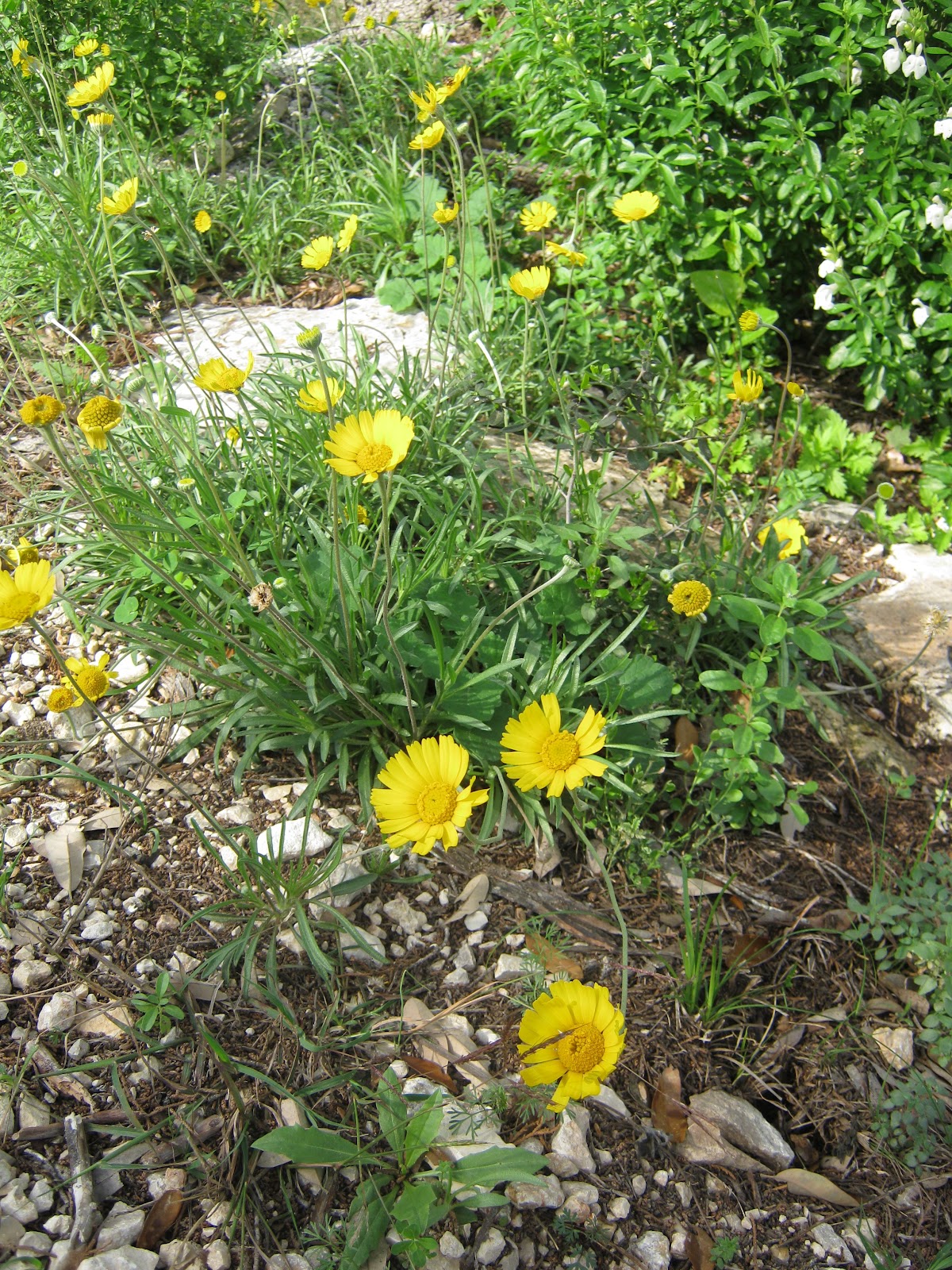
This little area is one of my favorites right now. In front, cedar sages (Salvia roemeriana) shoot up stalks of deep red, with yellow accents from the four-nerve daisy (Tetraneuris scaposa, I believe) against a backdrop of white autumn sage (Salvia greggii cultivar).

Out in the rock bed (which looks rather grassy at the moment), a volunteer fragrant mimosa (Mimosa borealis) has put on its pink and white puffballs. This plant occurs naturally on my land. Yellow Dahlberg daisies (Thymophylla tenuiloba) are blooming all over my yard, as is prairie verbena. The daisies are not natives, but after I planted some one year, they have self-seeded all over the front yard. This is okay by me, as I like the wildflower meadow look.

Looking out my French doors yesterday, I noticed the sun shining through the fresh green leaves of the crape myrtle and ran for the camera. Yarrow (Achillea millefolium), purple oxalis (Oxalis triangularis?) and wandering Jew (Tradescantia pallida) live underneath. The red bloomer is tropical sage (Salvia coccinea). This and the following picture are really more foliage shots, so I will be posting on Digging's Foliage Follow-up, also.

Last but definitely not least, I present this grouping out by the parking area. The only plant blooming here is the Jerusalem sage (Phlomis fruticosa - not a native), but isn’t it pretty with the century plants (Agave americana), nolina (Nolina lindheimeriana), woolly butterfly bush (Buddleja marrubiifolia) and cenizo (Leucophyllum frutescens)? 

Tuesday, March 19, 2013

Spring blooms in my garden


Bridal wreath (Spirea prunifolia)
Well, I really missed Garden Bloggers Bloom Day this time. I meant to post on the 15th . . . no, really, I did! But a family emergency put the kibosh on those plans.

And yet . . .

Plants are blooming in my yard, despite our drought. Truly, nature is amazing. Plants will bloom in spring, no matter the lack of rain or unseasonable heat or drying winds. Some of my bloomers are rather exciting (at least to me), so I'm posting today.

Spring! Hurrah!


This is one of my prizes:
I think it's a potato vine
(Solanum jasminoides). It
grew over winter, and is
blooming gaily now!

We are on the tail end of bloom time for the agarita
(Mahonia trifoliata) and the berries are forming.


Texas stars (Lindheimera texana) reseed freely in my beds and yard. These are native wildflowers.

The irises responded nicely to their spa treatment last fall.
These are the first blooms I've seen in three years.

Blackfoot daisies (Melampodium leucanthum)

This is my other prize! A neighbor bought this for me last year and it's finally blooming.
The desert globe mallow (Sphaeralcea ambigua) is native to the southwest (not Texas).


This awesome plant is death camas (Zigadenes Nuttallii). Yes, it's poisonous.


What's blooming in your garden? To see other GBBD reports, visit May Dreams Gardens.

Wednesday, January 16, 2013

GBBD: A day late and many blooms short.

 
Lantana montevidensis
As usual, I am posting for Garden Bloggers Bloom Day a day late, and this time it’s many blooms short, too.

Yesterday was very cold and gray, and I chose to stay inside near the woodstove. The lighting was terrible for photography, I told myself.

Today is still cold but quite beautiful and sunny, so I set out in search of blooms. They were sparse. I guess that’s to be expected in the winter, especially in a drought year.

Last week I saw a lone prairie fleabane bloom, but found none today. I’d hoped to see a wood sorrel blooming, but alas, it is too early. The only wildflower even attempting a bloom was a thistle I’ve yet to identify, because it is pesky and I don’t like it. No identification.

White trailing lantana.


The only other blooms were in my garden and on my porch:  trailing lantana. A freeze nipped the white awhile back, but it continued blooming. It is quite striking with its white blooms and blackened leaves. The purple lantana grows in pots by my south-facing front door, where it has been just warm enough to weather the light freezes we’ve received so far.

That’s all I’ve got.

You should visit May Dreams Gardens, host of GBBD, because I’m sure flowers are blooming somewhere in the world, and her site will lead you to them!

Thursday, August 16, 2012

There's no place like home.

I love these morning glories!!

There’s no place like home. <click click> There’s no place like home.

After most of three weeks on the road, we are settled in back home, awaiting the start of the school year.  We spent two weeks in Colorado (oh, those 45 degree mornings!) followed by a week touring southeast Texas visiting relatives.

Unloading the car after the Colorado portion, I looked around my woods, and thought, “Something’s missing.” I promptly realized it was the tall trees and mountains that I had been looking up to for the past 10 days.

Note from Colorado:  Did I mention we saw a bear? Pretty exciting stuff for us life-long Texans! Luckily we did not see him in our tent (!), but he was fairly close to our campsite, loping across the road in front of our car at straight up noon. I always thought this would be the perfect way to see a bear – when I’m in my car and he’s not.

Trusty summer bloomers - flame acanthus
(Anisacanthus quadrifidus var. wrightii).
Note from southeast Texas:  Do you know that people in southeast Texas use sprinklers to water lawns? I find I am mesmerized by sprinklers clicking and spraying water, not to mention by green lawns. Neither of these things is common in my neck of the woods.

The day after we drove north a huge storm delivered over two inches of rain. We came home to a tattered jungle. The rain powered a huge growth spurt, and then the heat put the whammy on all that new growth.

Bit by bit, I am watering and mowing. It’s too hot to do much out there (at or near 100 degrees each afternoon). But I will reclaim my yard, and slowly shape things up for the cooler weather to come.

I've featured these bachelor buttons (Gomphrena globosa 'Fireworks')
before - but they just keep blooming and spreading!

We had some casualties of our vacation:  we are down to two chicks out of the 12 we had before we left.  We’re not sure how they met their demise, though my husband did find and dispose of a 3.5-foot rat snake in the chicken coop.

This Brazilian rock rose
(Pavonia braziliensis)
piggybacked its way into
my garden.
(Truly, it’s a wonder chickens as a species have survived.  You may have read this here before, but let me reiterate: Chickens are not bright.)

Vacations are wonderful, and I do love the mountains, but I am glad to be home and am eager to resume my dispatches from the hill.

And no, Aunt Em, it was definitely not a dream!


As for wildflowers, the white heliotrope (Heliotropium 
tenellum) continue to steal the show. These are beside
my driveway and have gotten no supplemental water.
Wow!

Now for my Garden Bloggers Bloom Day report:

Thanks to that rain a month ago, my summer stalwarts are blooming. Things are hot and dry, but are a whole lot better than this time last year!  Hope you enjoy my blooms!

The flame-leaf sumac (Rhus lanceolata) is blooming and setting fruit. I've never noticed how lovely the berries are at this stage - then again, these might be the buds.
I happened to catch a bee enjoying the blossoms on the same tree.

Stop by May Dreams Gardens to see what’s blooming in a variety of other gardens.


Wednesday, May 16, 2012

Pretty, pretty.

I don't have a lot of these morning glories blooming now;
but the ones that are - are striking!

Well, it's Garden Bloggers Bloom Day again, and boy, do things look better around here than last year. In fact, I am a day late posting because we got an inch of rain yesterday - hurrah!

It has been a tremendous year in my area for Indian blankets (Gaillardia pulchella). I would show you a lovely picture, only they don't grow on our place! We have a few this year that popped up from seeds thrown a year and a half ago. Maybe they will spread seeds, and their offspring will be ready the next time perfect conditions arise.

Texas thistle (Cirsium texanum) taking over the septic drain field
Horsemint (Monarda citriodora),
also on the drain field.

Even without the gaillardias, the wildflowers are lovely here. As is usually the case, the flowers are best over the septic tank, with thistles, horsemint and Mexican hat taking center stage. I mowed out there a couple of months ago - but you would never know it. With the rain, however, we have things blooming in other places, too!

Mexican hat (Ratibida columnifera)
does well here.
Lady Bird's centaury (Centaurium 
texense) named for our beloved
Lady Bird Johnson.

Blackfoot daisies (Melampodium leucanthum)
are still blooming!

Dahlburg daisies (Thymophylla 
tenuiloba) are not native here,
but have naturalized in my yard.

Day flower (Commelina erecta) with rain lilies (Cooperia sp.),
naturally occurring in a flowerbed.


I hope you've enjoyed my blooms! Now head over to May Dreams Gardens to see what is happening in other gardens this month.


Monday, April 16, 2012

Rioting in the garden

My garden is a riot of color. Between the blooms and the butterflies - oh my. I can't show all that is blooming this April Garden Bloggers Bloom Day (hosted by May Dreams Gardens), but I'll give you a sampling.

In my flower beds, the yarrow (Achillea millefolium var. occidentalis) is putting on an eye-catching show.


Other flowers showing their colors include Texas lantana (Lantana urticoides) and the Engelmann daisies (Engelmannia peristenia). The daisies are showy on the roadsides in our area right now.


Blackfoot daisies (Melampodium leucanthum) continue blooming.

Cedar sages (Salvia roemeriana) continue to brighten a few shady areas. I want to spread these all over my property!

Out in the wild, lots more things are blooming. The two most prolific bloomers - in order of numbers - are the Drummond's skullcap (Scutellaria drummondii), which are carpeting the ground all around my house, and the prairie verbena (Glandularia bipinnatifida), both shown in this picture.

The prickly pear began blooming this week. I'm not sure, but we may have the Texas prickly pear (Opuntia engelmannii var. lindheimeri). The butterflies are so prevalent, you can hardly take a flower picture without one muscling its way into the frame. I think this is a painted lady, though it looks a little different than in my book.

Texas stars (Lindheimera texana - right) are still blooming, getting larger as the season advances.


The little darlings above have the most wonderful lemon smell when crushed underfoot; and I have just this minute figured out what they are:  annual pennyroyal (Hedeoma acinoides). They are native only to Texas, on limestone.

Zexmenia (Wedelia texana) has begun blooming. Last year, with the drought, it did not bloom at all. This is one of my favorite wildflowers here.

That's about it from the hill. Be sure to visit May Dreams Gardens to see what's blooming all over the place!


Sunday, March 18, 2012

March is blooming!

The big news this March Garden Bloggers Bloom Day is the incredible, lush greenery. Last March, the drought had already set in; not only were there few flowers, but not much green, either.

But this year I do have a few fabulous spots to report on, and here they are!

On our land, we have one big patch of bluebonnets (Lupinus texensis) blooming, and more scattered around that haven't come into bloom, yet. Bluebonnets are, of course, Texas' state flower.


 In my garden, the showiest blooms sit side by side:  bridal wreath (Spiraea prunifolia) and pink oxalis (Oxalis articulata f. crassipes). Oh my!

Other blooms in my bed are the autumn sage (Salvia greggii) out front and naturalizing four-nerve daisies (Tetraneuris scaposa - pictured here with a white autumn sage).

In the wild, the Texas stars (Lindheimera texana) are blooming. They will get larger and continue blooming through the spring.

Prairie (or plains) fleabane (Erigeron modestus - at least I think that's what it is!) is quickly becoming a favorite of mine.  It's tough, it spreads, and it's showy. Love it!

Prairie verbenas (Glandularia bipinnatifida) are also beginning to make a show. These are our most prolific wildflower here on the hill, and will continue blooming into the fall.

One of our favorites this time of year are what we call buttercups, which bloom in the evening and wilt away the next morning. We are surprised every spring when we stumble upon the first blooms some spring evening. As near as I can tell, these are Missouri primroses (Oenothera macrocarpa), though ours do not bloom as long as the book says they do.

Head on over to May Dreams Gardens to see more reports on March blooms!

P.S. If you think I've misidentified something, let me know. I am an amateur botanist, and most likely make mistakes!