Showing posts with label insects. Show all posts

Wednesday, May 1, 2013

Where the wild things are: on the hill!

 
Walking sticks have appeared
on our porch.
It must be spring, because all kinds of wild creatures are presenting themselves for observation at our country home.

We’ve seen some rare-to-us birds in the last few weeks. A golden-cheeked warbler perched on a branch outside our picture window a week ago, begging to be observed. These warblers actually are rare: they are listed as an endangered species. They only nest in the oak-juniper woodlands of Central Texas, and boy, do we have lots of home sites for them! We have continued to see him occasionally, and this morning we saw two––maybe a pair nesting nearby? This is the ultimate for an amateur naturalist––providing habitat for an endangered species!

Although this is a terrible picture, perhaps it's the perfect picture of a rare, shy endangered bird. Can you find him?
A Nashville warbler has been hanging around for several weeks, enjoying the birdbath. On Sunday, a summer tanager spent the day with us. We heard his call and knew he was not one of our regular visitors.  He finally landed on our picnic table so we could identify him.

Pine siskin (left) and Carolina chickadee
enjoy the seeds.

Another harbinger of spring (not at all rare) has arrived: chuck-will’s-widows. We’ve been hearing their night calls for several weeks.

A cottontail has been hopping around the yard. When we first moved in, many cottontails lived here. But we brought two cats and a dog with us, and the rabbits moved out.  We’re down to one rickety cat now, and this dog isn’t interested in chasing them.  I guess the rabbits (or at least this one) decided it was safe to return.

Our resident checkered garter snake finally woke up from his winter nap. My daughter and I startled him this weekend as he swam with the goldfish. He leaped out of the pond, and then slithered away slowly, and if to say, “Yeah, I’m back. It’s no big deal.” 

That same afternoon, I walked out into a field to inspect the first prickly pear bloom and heard a rustling to my left. I looked over to see a rather large snake crawling up a cedar tree.  I came back with binoculars and my budding herpetologist, and we spied him lounging on a branch about 40 feet high. We think he was a coach whip.

The fire ants are busy making trails across the driveway.
Of course, the whitetail deer are ever present. A pair skittered away as I went to my car one day last week. We don’t usually see them near the house, thanks to the presence of our dog, Iris.

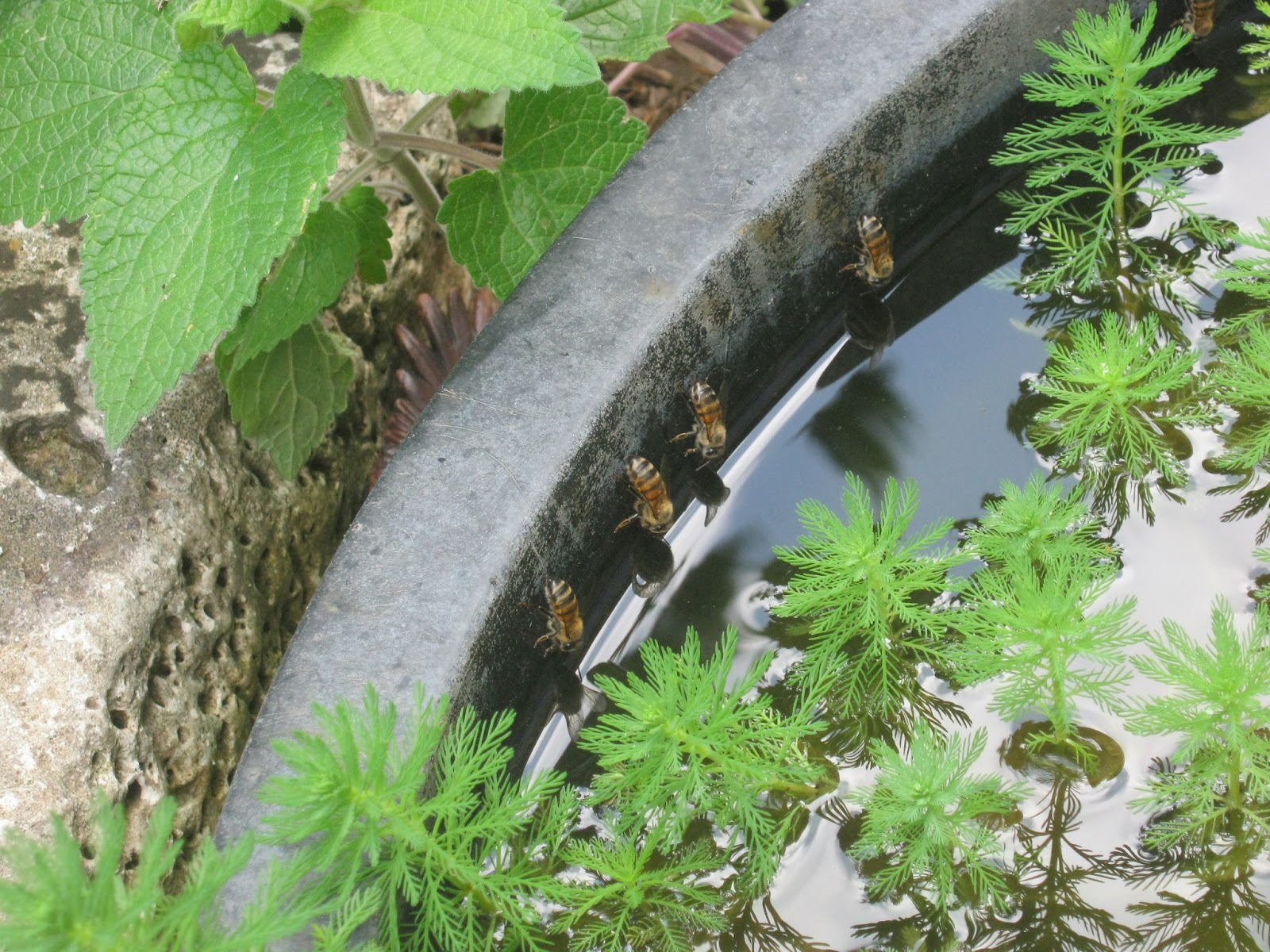
Bees!
Other recent sightings include a leopard frog squatting on the edge of the minnow pond. He appears to be dozing, but I’m sure if something edible came within reach he would leap into action. Lots of squirrels have been raiding our black oil sunflower feeders. My husband has harvested a few of them for our table. Free range, hormone-free, and . . . free! And before you ask, they taste like chicken––little bitty chickens.

Night before last, a coyote chorus serenaded us. We were sleeping with the windows open, on a quiet spring night. We awoke to the sounds of yipping and howling from the next-door neighbor’s property. I lay there smiling, because their song was so clear and distinct and perfect for the night. They sang for only a few moments, and then slipped away to their next engagement.

Oh, how I love living in the country!

Tuesday, October 9, 2012

From the ground

This grows wild, and looks a bit like lamb's ears.
 While kneeling on the ground to take pictures a few weeks back, I snapped two that led me to the idea for this post:  the view from the ground.

That's it. That's the theme.

I don't usually take the time to look at the world from the ground level, but it does provide not only a different perspective on things higher, but a closer look at things lower.

So without further ado, here are some views from the ground on the hill.

These well-worn boots decorate the new rock garden out front.
 Periodically Iris the dog decides they need a good gnaw, and drags them away.


Don't get excited - it's just a cow bone. Tropical sage (Salvia coccinea) is behind.
"Go away go away go away."
Blackfoot daisies (Melampodium leucanthum), Manfreda maculosa (I think)
and fallen cenizo  blooms (Leucophyllum frutescens).

My perfect native groundcover: straggler daisy or horseherb (Calyptocarpus vialis).
Fruits of fall labors - dead Ashe junipers cut into stove-sized pieces.


Wednesday, June 13, 2012

Katydid Cotillion


Well, the Katydid Cotillion continues in Hays County.

We aren’t ones to interfere with a good time here in my neighborhood. And these bugs have been having a really good time for the last few months – all over the trees, the houses, etc. Good time. The party really gets going after dark. The mating sounds, in aggregate, drown out conversations, outdoor performances and television.

Last night a cool breeze blew in, so we tried to sleep with the windows open. We lasted about 20 minutes, then jumped up and slammed the windows shut. It’s that loud.

Last week, we sat at a party on a neighbor’s deck, shouting at each other over the racket. A neighbor who is a biologist suggested that the overpowering buzzing might be interfering with mating rituals of other night species – owls, chuck will’s widow, frogs.  Maybe their ears are better than ours, but the katydids are the only things we can hear at night. We agreed that they are louder than normal this year, and speculated it might be due to the mild winter.

These katydids are Central Texas leaf-katydids (Paracyrtophyllus robustus) (from BugGuide.net). These little jewels dine on oak foliage, and are usually heard but not seen - except in outbreak years. Guess what, folks:  It's an outbreak year in Hays (and a number of area counties). In outbreak years, they are seen everywhere. I am disturbed to learn that they sing from late May to mid-July - they are nowhere near finishing.

Click here to hear what we've been listening to.

Our critters have very long antenna and tall angular bodies that serve as excellent leaf camouflage. We see both bright green and reddish brown ones – many of each. One is hanging out in around my laundry room as we speak. 

My daughter and I collected a big jug full of them last week (this required lots of squealing, jumping and running – on my part), and then carried the lot down to the chicken yard for a chicken rodeo. Let me just say, chickens like katydids. Yum.

So settle in, neighbors. The katydids are here to party, and they will be carousing for at least another month.

Coneflowers backed by Mexican oregano (Lippia graveolens).
Favorite spot in the garden:

The purple coneflowers (Echinacea purpurea) are blooming profusely right now. They are my daughter’s birthday flower, so we are always happy to see them blooming. I tried for several years to grow these, determined that they would live in my garden. After killing multiple plants, some finally survived, and have sowed offspring. If at first you don’t succeed, try, try again!

Wednesday, May 23, 2012

Cleaning up the world - one piece of excrement at a time.


On my walk last week, I glanced down and saw something that stopped me in my tracks. Two black  beetles were crossing the street while pushing a giant ball of – wait for it – dung.

“Darn it, where’s my camera when I need it?” I asked my faithful companion, Iris the dog. Her answer was a impenetrable glance, which I interpreted as “Well, you’re the blogger – it’s your responsibility” or maybe “Don’t look at me – I didn’t eat it.”

Being the technology maven I am, I whipped out the cell phone and snapped this picture. And being a cell phone picture, it does not tell the whole story. You will have to trust me that there were two beetles involved.

I first thought these two beetles were working cooperatively to move the ball back to their larder. Very impressive! Of course, ants work cooperatively, but I was surprised to see the beetles working in tandem.

But upon closer examination, I decided something else entirely was going on. One of the beetles was pushing the ball, while the other was clinging to it, riding round and round, scuttling like a lumberjack on a log to keep from being brushed off or crushed.

I imagined the conversation:

“Hey, this is my ball of dung! Leggo!

“No, finders keepers, it’s mine. Get off, it’s mine!”

“It’s mine! Stop pushing! I won’t let go!”

“GET OFF OF MY POOP!”

Or maybe this is the explanation (from Wikipedia):


The dung beetles roll and bury the ball for food or for a "brood ball." If for the latter, a male and female beetle will roll the ball. Usually the male rolls the ball and the female hitches a ride or follows along, but sometimes they will roll together. When they find a place with soft enough soil, they bury the ball, mate underground and prepare the ball; then the female lays eggs inside it. The ball provides food for the offspring. Some kinds of beetles will stick around to safeguard their young.

Oh. Apparently it was foreplay.

"Rainbow scarab," a dung beetle,  
Phanaeus vindex MacLachlan 
(Coleoptera: Scarabeidae), male (horned) and 
female. Photo by Drees. From 
http://insects.tamu.edu/fieldguide/bimg146.html
According to Texas A &M, there are a number of “tumblebugs” in the subfamily Scarabaeinae. Not all of them roll dung, some just burrow down in the dirt under poop piles.

Did you know that dung beetles dispose of 80 percent of the cattle droppings in some parts of Texas? These are beneficial bugs: since they reduce the amount of animal feces, they also reduce habitat needed by “filth-breeding flies.” I think we can all support that.

So if you see a beetle rolling a ball of poop along in your path, please don’t disturb him. He’s cleaning up the world, one piece of excrement at a time.

Favorite spot in the garden:


The day flowers  (Commelina erecta) seem to be at their peak right now. This patch is along (and in) a walkway near my porch – perfectly sited for viewing and appreciating! Day flowers bloom in the morning then close up, blooming for just one day (hence their name). They can be invasive, but aren’t at my house; perhaps because, according to the Wildflower Center, they prefer sandy soil, which I do not have.

Monday, February 13, 2012

Farmer Dan's garden


The weather was lovely on Saturday – or at least it looked lovely through the window. My husband, desperate to avoid cleaning out our shack, proclaimed, “We shall clean up the garden!”

Mixed lettuce - hurrah!
So out we trooped: my husband, daughter, father and I. My father, who was only an observer, scurried back to the house quickly. It was not quite as lovely as it appeared; a cold wind cut through our blue jeans.

Nonetheless, the rest of us persevered.

You may recall that I planted seeds in early December when I was playing Pioneer Woman. It was a leap of faith, as weathermen had prognosticated that the drought would continue and I had resolved not to water AT ALL.

The seeds germinated, thanks to continuing showers, then languished as young plants for a month or so. A freeze approached, so I covered that bed with row cover and left it in place.

Voila! The row cover’s heat- and moisture-retaining ability did the trick. Our garden contains flourishing lettuce, healthy but small spinach, turnips and Swiss chard (the last two are not quite so far along). I have not grown veggies in a long while, so this success is gratifying.

(My husband is the usual vegetable gardener. It says so on the garden gate.)

Interlopers overran the rest of the garden: thistles, hairy vetch, henbit, etc. We rousted them. Every one. We rousted them in such a vigorous fashion that we had to doff our coats. We rousted them so vigorously that I’ve been sore for the last two days. Then my daughter tossed the interlopers into the compost bin (they had not gone to seed yet, never fear!) and tromped on them quite thoroughly and disdainfully. “Take that!” I heard her shout. Or not.

Ready to plant. Yes, that is an eight-foot fence - deer proof!

In between disdainful tromps, she discovered egg cases of unidentified insects and adopted a millipede (“I shall call her Millie,” she said. Or was that I?)

My father reappeared to make sure we were following proper garden protocols.

Now are ready to plant. We are still in the same boat: we cannot, shall not water from the well. But rain continues, so we will plant the most drought tolerant vegetables we can find as early as possible and wish them good luck. Your good wishes are welcome, also.

Tuesday, February 7, 2012

Squeamish? Read no further . . .


Living in the country is not for the squeamish.

Here on the hill, our water comes from a hole in the ground, a.k.a. a well. Rainfall – or lack thereof – is a constant concern. Our well held out over the summer, but we know the supply is limited.

We try to conserve water in a variety of ways. Have you heard the expression, “If it’s yellow, let it mellow; if it’s brown, flush it down”?  Those on wells in drought-prone areas have.

Not for the squeamish.

Occasionally, we outpace the well’s ability to refill, despite our best conservation efforts. Several years ago our local well guru installed a mechanism to shut off the pump when no water is available, and turn it on again 30 minutes later. Occasionally we trip that shut-off.

About midway through December, I got careless and cleaned two bathrooms consecutively. The pump shut off. No problem, right? Just wait 30 minutes.

But this time, the refill took a few days, with the pump shutting off repeatedly. Even when the  pump was on, the water pressure was low in certain faucets. Husband Dan was puzzled; when you’re on a well you either have pressure or you don’t (unless you are running water somewhere else, which we weren’t). The well was refilling at a much slower pace, but why the low pressure?

I called the well guru (“Oh wise well guru, come to our aid in this time of duress”). He determined that we had, indeed, run the well dry. He suggested that we walk three times around the well head, pausing each time to sprinkle herb de Provence and sea salt over the top. Then the entire family should join hands in a circle around the wellhead and pray to Poseidon for life-giving liquid.

Alternately, he recommended installing a 2,500-gallon holding tank, so the well could pump at a more leisurely pace. Also, the tank could hold trucked-in water, should the well go dry. Many of our neighbors have these.

As it was two weeks before Christmas, I voted for the first option; my family refused to cooperate. We are still considering the second proposal.

A week later, my husband stood fuming in the shower under a teeny trickle of water, trying to understand this situation. Why was the water pressure so low? He got out, dried off, and unscrewed the shower head . . . and found a clump of dead ants.

Ants, full of ANTagonism toward humans. They are not thirsty now
with all the recent rain. In fact, their mounds have flooded down below
so they have pushed them above ground.


He roamed the house, unscrewing other slow faucets. They were likewise clogged with ant carcasses. This included the kitchen faucet.

Are you feeling squeamish now?

My theory: In the drought, the ants were desperately thirsty. They crawled down into the well seeking water. Some fell in and drowned – over time, lots of them. When I ran the well dry, the water level dropped to the pump, and the dead ant bodies floating on the surface of the water were sucked into our system.

We consoled ourselves with the fact that these ANTibodies might protect us from the fire ant ANTigens we encounter. Maybe we have received ANTivenin for ant bites, or perhaps it will just serve as an ANTidote to their stings. Either way, this incident did reinforce the ANTipathy we already felt for fire ants.

Was this disgusting? Oh, yes. But we survived. I guess we're not too squeamish for the country.

Favorite spot in the garden:

Actually, this spot is on my kitchen windowsill. My mother-in-law brought some sprigs of flowering quince from her garden. When I stand at the sink and try to look out the window, my eyes are drawn instead to these lovely blooms. They seem somehow Asian – simple, lovely. In her garden, this looks much redder. On my mustard windowsill in fluorescent light, it became salmon-hued. It's lovely no matter the setting!

Tuesday, July 26, 2011

Oh, the horror!


We have a horror film showing right out in our garden. Really.

Here’s my young associate to tell you all about it:

 Aaagh! Giant wasp!

This is the wasp that inspired such terror. 
No really, he's bigger than he appears here.
Flying drunkenly through the bridal wreath, (Spiraea prunifolia) it cruised through the salvias, (Salvia coccinea) then dropped to the ground like a rock. Feeling like a maiden in distress, I leaped onto the porch, screaming “aaaaaahhgg!!!” in my head over and over again. We had seen this humongous wasp before, but not up close, like this.

The man of the house decided it was a tarantula hawk wasp (Pepsis thisbe/Pepsis formosa). I didn’t care what it was, it had a huge stinger, so keep it away!!!!!!! It turns out this formidable creature was something like a horror movie character. One researcher cited on Wikipedia described the wasps’ sting, “Immediate, excruciating pain that simply shuts down one’s ability to do anything except scream.” Apparently, the intense pain lasts only about 3 minutes, but hey, I’m not one to test theories. Luckily, unless harassed, they usually don’t sting

Here’s how the tarantula hawk wasp got its name:

Imagine this…

It’s a muggy late August evening in Texas. The scent of fermented fruit and rain drifts lazily to you. A fat male black wasp with rust colored wings sits on top of a tall salvia bush. This, you know, is called hill-topping. Suddenly a female wasp drifts lazily through the path of flowers. The male, needing a mate, chooses this fine feminine wasp.

Shortly after we identified the wasp, my young associate noticed 
a motionless tarantula beside the path - which was soon joined by 
a tarantula hawk, which then dragged the tarantula away. 
Both these photos were taken by my associate.
After a few days, this female locates a tarantula. Diving in on the tarantula, the battle begins!!  The tarantula wheels up on the wasp, ready to defend itself. The wasp seizes her chance and stings the tarantula under the belly, touching a nerve, and paralyzing it. Unable to fight back, the tarantula is dragged to a hole in the ground, and, rudely, it can be his or her own hole! Talk about unwanted visitors!!

The female wasp then lays a solitary egg in the tarantula and covers the hole. She then leaves the hole to who-knows-where.  The larvae hatches, and begins feeding on the almost dead, paralyzed tarantula.

According to Wikipedia, after a few weeks, the larvae pupates. Then, it breaks free!!!!

And if you happen to see a tarantula hawk wasp drifting drunkenly around, remember this: fruit for the wasps is like alcohol for us humans. Too much makes them drunk!

Favorite spot in the garden:

As a said on the last post and will say on the next, the garden looks very grim. One bright spot is the volunteer morning glories. We planted this lovely deep purple variety last year. The new seeds I planted this year did not survive, but the offspring  of last year’s plant are doing very well. I am slowly training them to head up the porch posts, but without rain it is slow growing.