Showing posts with label critters. Show all posts

Wednesday, June 19, 2013

A pond story

 
Last year we put together a small water feature outside our living room window (you can read about that here). I thought it would be pretty, and that we would enjoy the soothing sounds of trickling water, both outside and, when we could open windows, inside.


But it has been so much more.

Last week my daughter called me to come look at something. I was halfway up the stairs toting the vacuum cleaner (why is that invariably when someone calls for you?). Somewhat grumpily, I set the vacuum cleaner down on the landing and trudged back down to my daughter, who was pointing out the window at the new pond.

“Look, it’s the snake,” she said.

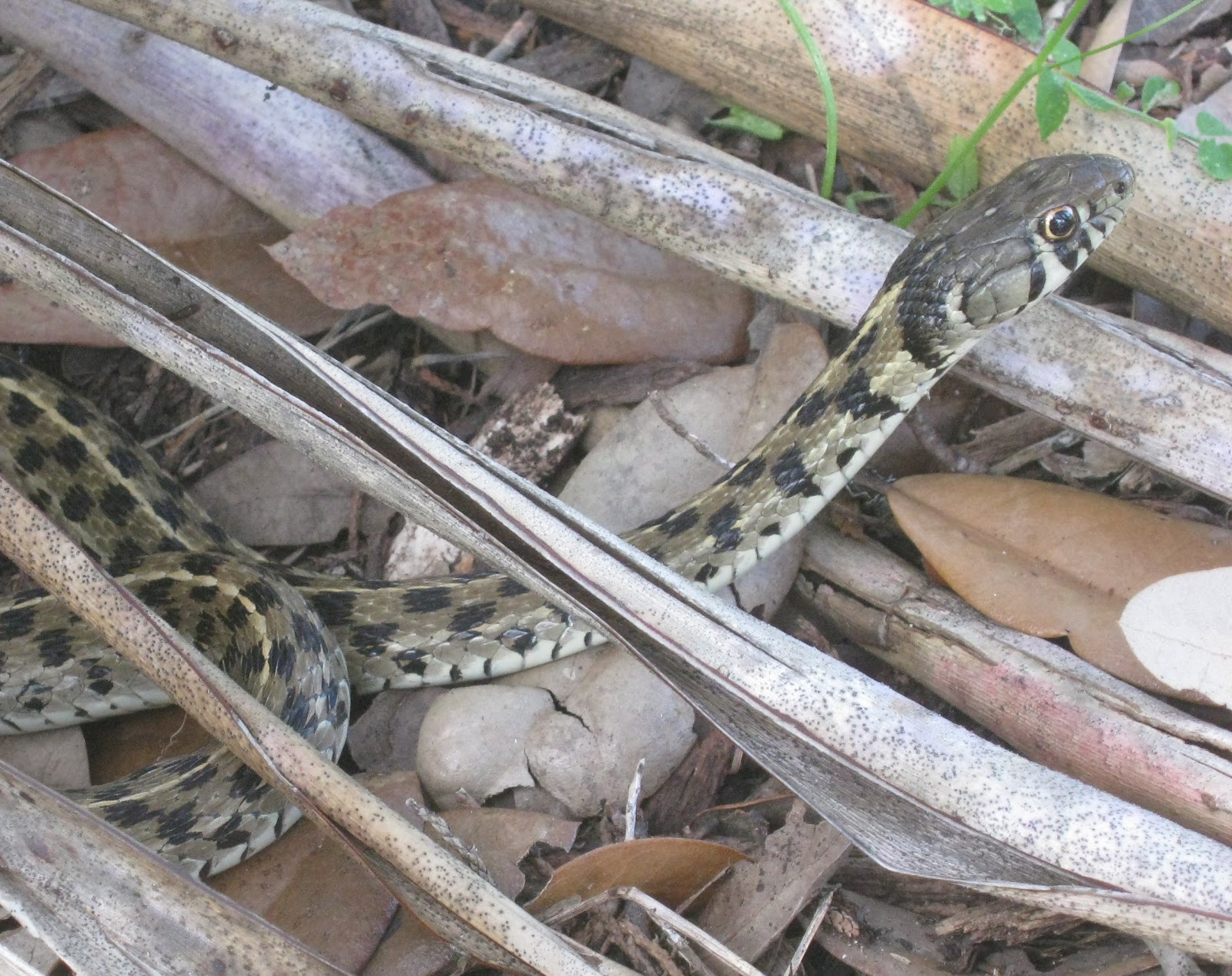
Sure enough, a checkered garter snake was swimming in the pond.  We have seen this non-venomous snake in this area many times (see Just a member of the family).

Grumpiness be gone.

We watched him as he swam around. Soon he began writhing under the water splashing into the pond from the water spigot. He did this several times – at first we thought he was trapped under it, but soon we concluded he was doing this because it felt good.

The goldfish were also swimming about, no doubt watching him warily. We decided this was a different, smaller snake than we’ve seen here before, and that the goldfish are big enough to be safe. My daughter was concerned, however, about the small leopard frog who also lives in the pond.

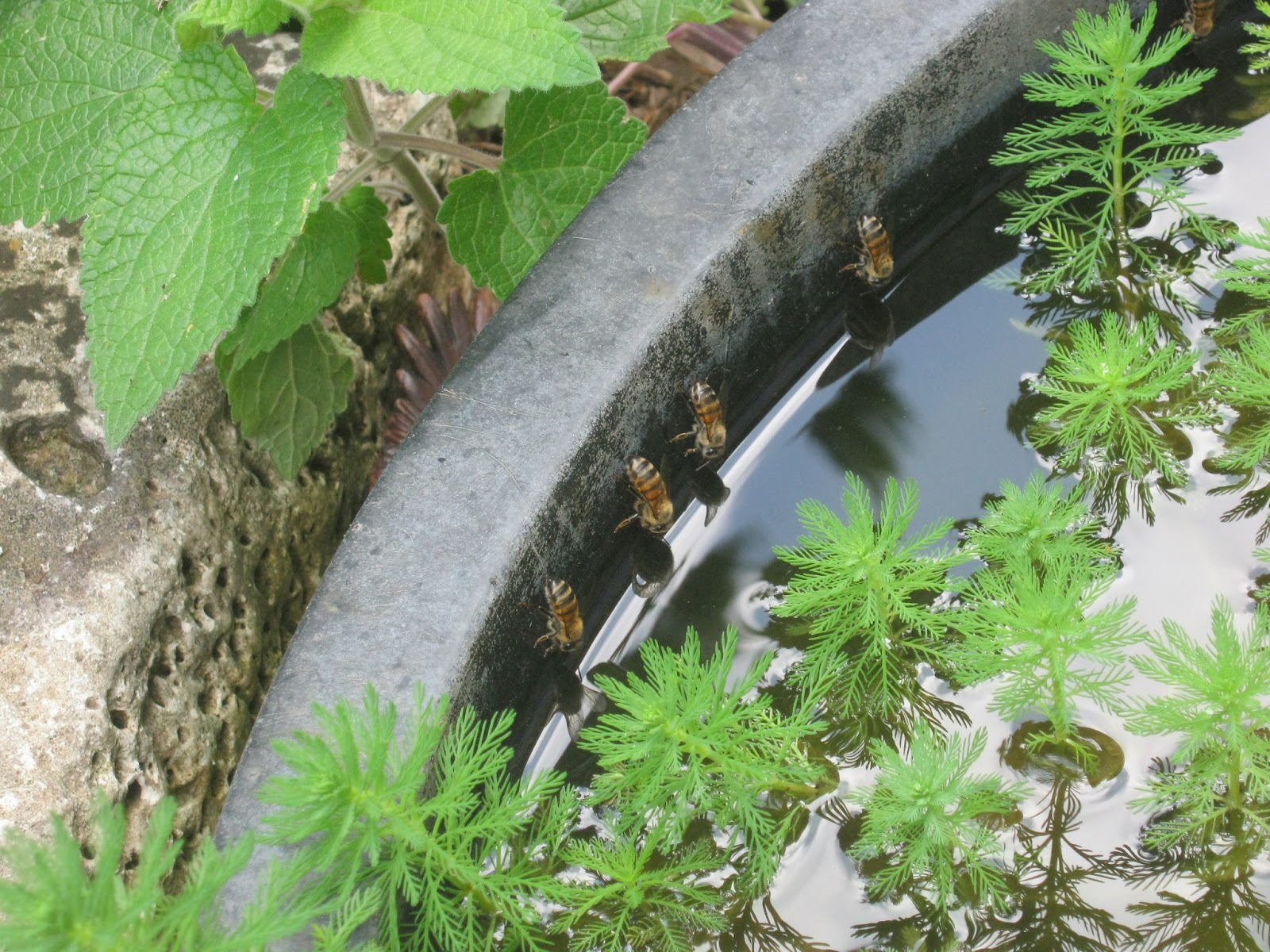
Bees drink from this pond all day long, gathering on the edge in a cluster, and then flying off to their work. One day my daughter told me she had touched a bee on its back – how cool is that.  I wondered if this snake might eat bees.

My nature lover daughter could only watch from afar for so long, and then she headed outside. Mr. Snake watched her draw near, and then beat a hasty retreat to the rock pile in the corner.

When I swung by the window 15 minutes later, he was back, swimming around, resting his head on the rock or edge of the pond, writhing under the waterfall.

Meanwhile, a female painted bunting came fluttering by for the drink. I stood still, thinking, “Watch out for the snake, little bird!” Instead of perching on the rock to get a drink, where she would be within the snake’s reach, she lit on the water spigot about a foot above the pond. I watched her lean over to snatch drops of water from the spigot’s spout. Smart bunting.

I decided two things about the little snake:  it was hungry and it was hot. The pond took care of both of his problems, apparently.

We’ve not seen him since. Nor have we seen the little frog.

Favorite spot in the garden:

Several years ago my friend Lona gave me some  phlox after I admired her very healthy stand. I planted them in the wrong place, with too much shade. They did not thrive. After three years or so, I figured out the problem. I moved them over about three feet to a sunnier location. This spring, they are putting on quite a show for me, and I “ooh” and “ah” every time I walk by. Garden success!

Wednesday, May 1, 2013

Where the wild things are: on the hill!

 
Walking sticks have appeared
on our porch.
It must be spring, because all kinds of wild creatures are presenting themselves for observation at our country home.

We’ve seen some rare-to-us birds in the last few weeks. A golden-cheeked warbler perched on a branch outside our picture window a week ago, begging to be observed. These warblers actually are rare: they are listed as an endangered species. They only nest in the oak-juniper woodlands of Central Texas, and boy, do we have lots of home sites for them! We have continued to see him occasionally, and this morning we saw two––maybe a pair nesting nearby? This is the ultimate for an amateur naturalist––providing habitat for an endangered species!

Although this is a terrible picture, perhaps it's the perfect picture of a rare, shy endangered bird. Can you find him?
A Nashville warbler has been hanging around for several weeks, enjoying the birdbath. On Sunday, a summer tanager spent the day with us. We heard his call and knew he was not one of our regular visitors.  He finally landed on our picnic table so we could identify him.

Pine siskin (left) and Carolina chickadee
enjoy the seeds.

Another harbinger of spring (not at all rare) has arrived: chuck-will’s-widows. We’ve been hearing their night calls for several weeks.

A cottontail has been hopping around the yard. When we first moved in, many cottontails lived here. But we brought two cats and a dog with us, and the rabbits moved out.  We’re down to one rickety cat now, and this dog isn’t interested in chasing them.  I guess the rabbits (or at least this one) decided it was safe to return.

Our resident checkered garter snake finally woke up from his winter nap. My daughter and I startled him this weekend as he swam with the goldfish. He leaped out of the pond, and then slithered away slowly, and if to say, “Yeah, I’m back. It’s no big deal.” 

That same afternoon, I walked out into a field to inspect the first prickly pear bloom and heard a rustling to my left. I looked over to see a rather large snake crawling up a cedar tree.  I came back with binoculars and my budding herpetologist, and we spied him lounging on a branch about 40 feet high. We think he was a coach whip.

The fire ants are busy making trails across the driveway.
Of course, the whitetail deer are ever present. A pair skittered away as I went to my car one day last week. We don’t usually see them near the house, thanks to the presence of our dog, Iris.

Bees!
Other recent sightings include a leopard frog squatting on the edge of the minnow pond. He appears to be dozing, but I’m sure if something edible came within reach he would leap into action. Lots of squirrels have been raiding our black oil sunflower feeders. My husband has harvested a few of them for our table. Free range, hormone-free, and . . . free! And before you ask, they taste like chicken––little bitty chickens.

Night before last, a coyote chorus serenaded us. We were sleeping with the windows open, on a quiet spring night. We awoke to the sounds of yipping and howling from the next-door neighbor’s property. I lay there smiling, because their song was so clear and distinct and perfect for the night. They sang for only a few moments, and then slipped away to their next engagement.

Oh, how I love living in the country!

Friday, January 18, 2013

My daughter's view of nature

Tree frog found when we were cutting drought-felled trees.
My daughter (age 11) has been roaming the great outdoors with a digital camera in hand over the past several months. She likes getting very close to her subjects, and she's gotten some nice shots. I like that she is outdoors exploring nature up close and personal!


Silver ponyfoot (Dichondra argentea) (above and below)


Wood-sorrel.  


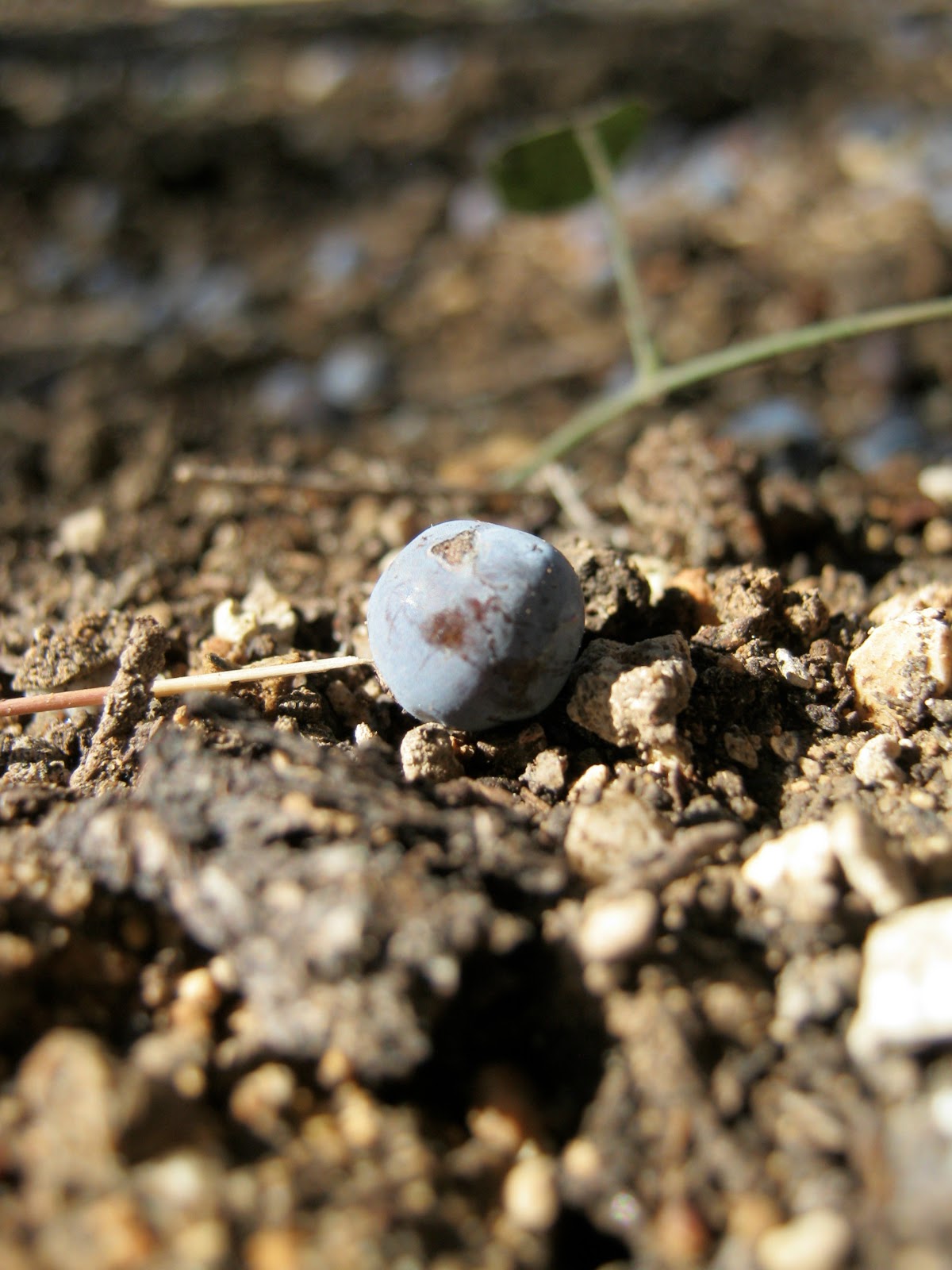
Ashe juniper berry.
Yarrow (Achillea millefolium).

Wood-sorrel (Oxalis drummondii).
Since so many of these are foliage shots, I am linking to Pam at Digging's Foliage Follow-up meme. Foliage is an excellent thing to focus a camera lens on at this time of year, when blooms are few and far between.

We hope you enjoy!

Wednesday, November 14, 2012

In the woods


This was the tallest tree we tackled.
Sunday we spent some family time in the woods. We were doing a job that I enjoy, that exhausts my husband, and that really annoys the children:  slaying cedar.

Technically, we weren’t slaying cedar (Ashe juniper is its correct name), as they were already slain – laid low by that terrible foe, the drought of 2011. A belt of trees were geographically challenged in their quest for water, and a number of them – Ashe juniper, live oak and yaupon – perished. This left an unsightly mess next to the driveway.

And according to our calendar and much to our dismay, it will get cooler here soon and the firewood supply was perilously low.

And it's down, destined for firewood.
It was time to take action. We donned long pants and boots, and gathered chain saw, fuel, bar oil (or as my husband says, bahr awl), gloves and loppers, and ventured out solve two problems at once.

My boys were enlisted to drag brush frequently when we first bought this land, and it was a battle every time. Now they are out of our clutches, and we have shifted our sights to the little daughter. She has begun exhibiting the same reluctance her older brothers did. On Sunday I heard things like, “I don’t have any shoes” and “Can I make a pie, instead?” No.

Iris the dog is site supervisor.
I set her to using the loppers to break off dead branches and cut small cedars; she prefers this to dragging brush. Dan wielded the chain saw, while I stacked firewood and piled up brush.

In addition to the reward of how the area looks when we are done, we usually find a few surprises or treasures to make the job more enjoyable.

The first thing we saw was a giant pink and cream lantana, escaped into the woods and twining up through a cedar tree. It is far from where I had planted one in my garden. The thing is at least six feet tall!

Green tree frog and daughter's hand against
freshly cut Ashe juniper stump.

A while later, Dan called our daughter over. As he was prepared to take down a dead cedar, he discovered a bright green tree frog on its trunk. My daughter was entranced, of course, and carried the frog back to the house where she constructed a home for it near the new pond - deluxe accommodations that I’m not sure it will appreciate.

(Have I mentioned how much I love having a daughter who is not afraid to pick up a frog or toad?)

Tote that wood, sister.
It was a productive day:  dead trees cleared away, firewood stacked, brush pile created (which may be chipped sometime, but until then will be home to sundry critters), unexpected plant found, frog examined and relocated, fresh air taken in, muscles used, pre-teen ejected from the house, sense of accomplishment felt all around.

The finished-for-today product - more dead trees remain for another day.

Thursday, September 6, 2012

You just can't rush these things . . .


This weekend, thanks to my husband, we finished a long-term project.

Several years ago, Dan bought a fountain pump and peripheral equipment for my birthday. However, my original plan for its placement required still more peripheral equipment – a longer cord. Six months passed before I obtained said cord.

Before . . .
Now the job had turned into a big, complicated electrical one. These types of jobs require lots of planning, perhaps an environmental study or permit.  Maybe it would require the blessing of a uniformed officer of the electrical code.

Six more months went by, with the equipment residing on the laundry room counter.

Then came a Eureka moment:  I should put a pond right outside my living room window in a bed still to be developed! This would be much closer to the house, ergo closer to the electrical outlet thereby simplifying the job.  I rushed out to buy the pond, lugged it home and set it in place.

Six months passed. The pond collected water from roof run-off and became home to some minnows, dead bugs, an occasional waterlogged toad and green pond sediment.

Look, I even used tools!
In early spring, something moved inside my soul. I knew it was time for the next step in this project. My husband finished moving rocks. I moved dirt and plants to surround the pond. Now, it was a flowerbed! A flowerbed with a pond! Maybe now . . .

No. Six more months elapsed. The plants grew, the minnows swam, but alas, the sound of tinkling water did not fill the air.

Sometime during this period, I saw a cool idea on Pam Penick's Digging. She had visited another gardener and seen her fountain, and then copied the idea for her own garden. These two gardeners had rigged a fountain to run water through a hose bib. I found a discarded hose bib and decided to follow in their footsteps (the sincerest form of flattery, right?).

Labor Day weekend arrived. While discussing what projects we could undertake, I suggested that perhaps my dear husband could get the fountain up and running. I pulled up Pam’s page to show him how her husband had managed this engineering feat.

My husband hemmed and hawed, then struck out for the hardware store. Like Pam and Cat, he bought metal plumbing pipe and elbow joints. He assembled the pieces of pipe and set the unit in a one-gallon plastic plant pot, then mixed some concrete and poured it in. The bottom of the pipe stuck out the side of the pot/concrete. When the concrete was dry, he cut off the pot, connected plastic tubing from the pump to the bottom of the pipe, and set all in the pond. He did a little hocus pocus electrical work, and then plugged in the whole apparatus. Water began splashing gaily into the pond! Hurrah!

This little fella was in the
pot I moved - the first new
resident of our revamped pond!

I placed a sad little water plant from the other pond beside the concrete block – I’m hoping the cooler water and shade will provide it a better home. Four big beautiful goldfish now populate this more upscale pond.  

Now we are eager for cooler weather so we can open the windows and hear the soothing sound of water splashing right outside.

. . . and after! The bed is home to Turk's cap (Malvaviscus arboreus var. drummondii),
heart-leaf skullcap (Scutellaria ovata) and a white potato vine (Solanum jasminoides).


Wednesday, April 11, 2012

Just a member of the family . . .


One morning last week as I trundled a wheelbarrow load of garden soil, I startled a snake crossing the rock sidewalk. I watched him – warily, it’s true – as he slithered into the “red bed,” and underneath a yucca.

He/she was a non-venomous checkered garter snake (Thamnophis marcianus marcianus). I am not a snake whiz, but we’ve seen this little critter several times. Last year, my husband caught him for the budding herpetologist to get acquainted with. The snake did not really enjoy this process, and before it was all over . . . he bit her. Her first snakebite!

This is the third or fourth sighting of a checkered garter snake near the side porch. Apparently it lives here as another member of our family, albeit a shy one. If so, its survival is impressive, as we have a cat. He is an old cat, though. Perhaps he’s a bit slow.

Today I consulted our A Field Guide to Texas Snakes (Alan Tennant) to look up the checkered garter snake. My picture matches the one in the book, so our identification seems to be correct.

According to the guide, our snake friend is common across Texas, except in East Texas. In Central Texas, it likes grassy upland areas near water, “where it is widespread but not numerous.” We see it near our ponds. And the reason it likes water: it eats worms, tadpoles, mice and frogs. In fact, one of our sightings was of the snake with a toad halfway down its throat.

These snakes bear live young, around 8” long, between late May and October. When full-grown, they average 15 to 28 inches in length, with one on record at 42.5 inches.  Ours is probably around 2 feet long.

The guide says that these snakes rove around at dawn and dusk in the spring and fall, and are completely nocturnal during the hot months. However, most of our sightings have been in the daytime.

An interesting historical tidbit:  the snake is named for Capt. Randolph B. Marcy. In 1852, Marcy mounted a two-month expedition to explore undocumented parts of the Texas and Oklahoma territories. He was the first white explorer of Palo Duro and Tule canyons and discovered the sources of the Red River. He also discovered 25 new species of mammals and 10 of reptiles, including the checkered garter snake. (Information from The Handbook of Texas Online.)

I guess we should give this fellow a name, if it’s going to hang around. Any ideas?

Favorite spot in the garden:

The blackfoot daisies (Melampodium leucanthum) and prairie verbenas (Glandularia bipinnatifida) are throwing a big party to celebrate the wet spring in the dry bed out front. Their colors juxtaposed against the century plant, woolly butterfly-bush (Buddleja marrubiifolia) and cenizo are very nice. Very nice, indeed.

Friday, October 28, 2011

An autumn walk


Earlier this week my daughter (home sick from school - but not too sick!) and I set off to explore a dirt road that runs along our property, as part of This Grandmother's Garden's Autumn Walk Challenge. I've been wanting to traipse this road, and now I have a good excuse. 

Technically, we are trespassing, which makes my daughter very nervous. The road is an easement  to which we do not have access. But it washed out from flooding a year ago, and we very rarely see a vehicle navigating it. I'm sure the owners would not notice or mind two intrepid explorers.

We crawl through our rickety bobwire fence to embark on our expedition. My daughter immediately spies these copper-colored rocks amid the usual limestone. The nice thing about walking with a child is that she has sharp eyes for things on the ground . . . 
We head down the hill, where water drains across a low in big storms. I promptly slip on loose dirt and land - oh, so gracefully - on my rump. Only my pride injured, we continue on.

The ravages of drought (summer of 2009 and current) are quite evident. Up on top of the hill, live oak skeletons jut above dead or stressed Ashe junipers. I'm betting if the junipers are this color, they are goners. Fall color, Texas-style!


We spy this field of rocks to our left. I'd like to come up with some clever play on "Field of Dreams" but I just don't have it in me today. I will say that we grow great rocks here in Hays County. It's our best crop.

All too soon we arrive at this locked gate. I figure two locks are a pretty strong indicator that the owner is not interested in receiving visitors. We turn around.

My daughter points out the Ashe juniper berries, which are a lovely shade of blue. I in turn admire the interesting texture and color of some live oak deadfall.

Iris the dog leads the way. The road is dotted with cowpies left by Henrietta (do you remember her? She has been wandering loose on this road recently).

We pass by our property heading south toward Henrietta's home pasture, admiring our next door neighbors' well-tended, cross-fenced property - a sharp contrast to our place where nature reigns supreme. Down the way, we note the broken fence Henrietta has repurposed as a gate. 

Some might consider our next discovery gruesome, but we think it is our most interesting find: a coyote carcass. We hear coyotes frequently, but see them never. This carcass is quite desiccated and not too stinky. I suspect it may have been shot by Henrietta's owners and hung on the fence as a warning to its pack mates. "Keep out!!"
A short way past this treasure, some cattle panels have been rigged to block the road. My guess is that this was done to keep Henrietta from reaching the county road (in lieu of fixing the fence!). We turn around again.

At the corner of our property and the well-tended neighbors' is a small gap that we decide to use to get back home, just for fun. My daughter is convinced that I won't be able to squeeze through, but I do. She, of course, has no trouble.

The original purpose of this walk was to find fall color, so we track down one fall-blooming wildflower we both adore:  wood-sorrel (Oxalis Drummondii). Nearby, we spy what we think are Texas bluebonnet seedlings, germinated after our recent rains. 

Home again, two happy girls after a lovely autumn walk.


Friday, October 7, 2011

For the birds


Through the window - Northern cardinals, 
lesser goldfinch and house finch.

I spent a very entertaining 15 minutes outside yesterday. As I returned from walking, I heard a rustling noise. Rain? Of course, that would be exciting – but no drops dotted the rock sidewalk. I stepped out from under a tree to see if I felt drops . . .

. . . and realized that birds were making the rustling sounds.

I paused about 10 feet from a bird feeder, arms akimbo, and just listened. The birds were everywhere, wings flapping as they flew from tree to tree, chirping, singing, pecking at branches. So cool!

After a few minutes, a few birds bravely ventured onto the feeder, followed by some of their more timid brethren. I watched as goldfinches, cardinals, chickadees, tufted titmouse and a house finch picked up some breakfast sunflower seeds.

When I slowly crossed my arms, they abandoned the feeder, but continued flying about the yard, along with white-winged doves and wrens.

My in-laws have a friend who is a nut for birds. He told them they were “birdwatchers” and not “birders;” a birder is someone who travels specifically to see a bird. Last year they traveled to New England and saw puffins; they informed him they were indeed “birders.”

Carolina chickadee.
We, on the other hand, are birdwatchers.  My husband has actually studied our bird book and knows quite a lot; my interest is more – observational, I guess. They are a beautiful addition to my yard. I like to watch them, but I don’t spend a lot of time learning about them.

Earlier this year, marauding house sparrows were gorging themselves on the mixed birdseed we put in our three feeders. They emptied those feeders in a matter of hours. These sparrows are not lovely. Like Wal-mart shoppers on Black Friday, they are rowdy, greedy and pushy.

One day it dawned on me that serious birders (like my in-laws) use specific kinds of seeds to attract more desirable birds. I did some online research, and then went shopping for black oil sunflower seeds and thistle.

To my amazement, it worked! The sparrows skedaddled. Even better, the bird population on the hill has diversified. We have seen a few new species, perhaps also due to drought conditions. Because of this, my interest in them is keener.

Carolina wren.
Here’s our bird list:

Regular visitors (to our property):  Northern cardinal, white-winged and mourning doves, Carolina chickadee, tufted titmouse, lesser goldfinch, house finch, Bewick’s and Carolina wrens, black-chinned hummingbird, greater roadrunner, scrub jay, black and turkey vultures, red-shouldered hawk, Eastern screech owl, chuck-will’s-widow, painted bunting,

Occasional visitors: golden-fronted and ladder-backed woodpeckers, oriole, summer tanager, mockingbird, golden-cheeked warbler, yellow-billed cuckoo, American crow, common ground-dove, blue-gray gnatcatcher, American goldflinch, cedar waxwing, Nashville warbler, dark-eyed junko, tree sparrow, great-tailed grackle, brown-headed cowbird, Eastern starling, Eastern phoebe.

Flyovers:  snow geese, sandhill cranes, Mississippi kites, white pelicans, crested caracara.

Now if I could just find my binoculars, I could go see if something new has stopped by.

Favorite spot in the garden:

When we moved to this place, I transplanted very few things, as I knew it would be awhile before I could plant. This shrub, however, made the cut. I think this is a shrubby blue sage (Salvia ballotiflora), native to my part of the state. 

At our old place it was out by the fence line. Its bloom is so very discreet, you must be standing right beside it to enjoy its loveliness. Here, I planted it at the edge of the porch, so I can enjoy its quiet beauty.

It stressed this summer, but with the recent ½” rain and resultant roof run-off, it has begun blooming. Love it!

Friday, August 26, 2011

Just doodling around . . .


Doodle, doodle, doodle,
Bug, bug, bug.
Doodle, doodle, doodle,
Bug, bug, bug.
That doodle would jump up and look all around,
And doodle back in the ground.

When my boys were young (now they are 21 and 19!), we had a set of cassettes called “Animal Folk Songs for Children.”  These cassettes contained all manner of fun folk songs, but the one I really liked at the time still lurks in the back of my mind. Periodically it surges to the fore, and I have to sing it (I may not remember the words correctly).

What leads to this vocal eruption is the sight of the little doodlebug pits. This year we have several large colonies (do they colonize?), more than I remember having before.

As a child, I remember doggedly digging to catch one of the little critters. I never could. I did not know the proper technique. I didn’t even know what they looked like.  (I was not a brave child, so it’s a wonder I was willing to go burrowing into the dirt after an unknown insect.)

Of course my daughter catches them easily. Here’s her technique: She grabs a big handful of sand that contains the pit, then streams the sand through a narrow opening in her hand into her other hand, until the doodlebug lands on her palm.

Doodlebugs, or antlions (Myrmeleon spp.), are the larvae of insects resembling damselflies. The larvae make their pits by burrowing into the dirt backwards, moving in a circle and flinging sand out using upward jerks of their heads. They lurk in the bottom of the inverted sphere with only their jaws exposed, waiting for a passing ant or other small insect to fall in.  Each larva, according to A Field Guide to Common Texas Insects, digs multiple traps as it develops. The Antlion Pit (a website devoted to all things antlion) says the bigger the hole, the hungrier the antlion! 

It's clear how they got the name "antlion." But what about "doodlebug"? The Antlion Pit says that name comes from the doodles the critters leave in the sand as they move around. I'll have to go look for those!

I don’t know which name I like more – doodlebug or antlion.  There is that catchy little song. But, picture tiny lions laying in wait, then springing out with a roar to attack even tinier ants – roar!!!!!! 

These little critters are considered beneficial insects because of their ant depredations. So take your pom-poms and head out to the nearest antlion colony to cheer them on:  GO BIG LIONS!

Favorite spot in the garden today:

Even the prickly pear are desiccated.
Due to our drought, much of the native grasses have moved past the gold color we often see in hot spells into the rust that we see in the winter.  As a result, the roadsides are quite beautiful right now, if you can avoid thinking about why they are this lovely color.

As I was walking around our place recently, I noticed a pretty little grouping – green prickly pear (Opuntia engelmannii var. lindheimeri) surrounded by red clumps of little bluestem grass (Schizachyrium scoparium). These clumps are usually a foot or two in diameter, and should be sending up seed stalks about now. Instead they are about 6" in diameter, and nary a stalk can be found. 

When I went out to take the photo this morning, I discovered a lone red tuna atop the cactus.

Even in deep environmental distress, beauty can be found!

Down the driveway.