Showing posts with label chickens. Show all posts

Saturday, March 9, 2013

2013 Great Backyard Bird Count results


Several weeks ago we participated in the Great Backyard Bird Count for the second time (see Counting birds for fun for last year's report). As I wrote last year, I am not much of a bird watcher, but the tallying and submitting appeals to my accountant’s soul.

Look - there's some birds!
It is fun to see what’s out there, but it can also be frustrating. I ventured away from the house at one point, to see what was in the woods. I could hear a bird, but could never find it with my binoculars. I’m sure a real birder would have been able to track down her quarry.

Also, someone scheduled this event on a weekend when I had another activity on the agenda. They should have checked with me first, darn it. As a result, I only counted for two of the four days. So if you’re reading, GBBC, please be sure to check with me before you set the date for next year’s count. Thank you.

We had three watchers this year, as my dad was visiting. Here’s how it works:  You count birds for at least 15 minutes at a time, marking down the most birds of a species that you see at one time. So the numbers below are the most we saw at a time during the two days of sporadic counting.

We saw 14 species of birds. Here are our results:
 
I don't think these photographers use a
point and shoot! Photo by Jennifer Taggart, 
from the GBBC website.

Turkey Vulture (5)
Red-shouldered hawk (1)
White-winged dove (5)
Mourning dove (1)
Greater roadrunner (2)
Carolina chickadee (2)
Black-crested titmouse (3)
American robin (3)
Cedar waxwing (6)
Chipping sparrow (2)
Northern cardinal (8)
House finch (2)
Pine siskin (12)
Lesser Goldfinch (2)

Last year we had oodles of lesser and American goldfinches, and a few pine siskins. This year, we saw only one pair of lessers, but oodles of pine siskins. I really liked these pine siskins at first, until I realized they were sitting on the bird feeder and throwing seeds out like a toddler throws cheerios. I don’t know what they are looking for, but there are only black oil sunflowers in that feeder and no prize at the bottom.

The cedar waxwings heard through the grapevine about the count and very kindly dropped by so that we could admire and add them to our list. We had not seen them before the count weekend, nor have we seen them since.

For 2013, counters have submitted 134,935 checklists, identified 3,610 species and counted 34,512,432 birds. Click here to learn more about the GBBC.

And in looking up this information, I see that they have already set next year’s date, Feb. 14-17, 2014, without consulting me.  Well, at least I have a year’s notice.

Thursday, August 16, 2012

There's no place like home.

I love these morning glories!!

There’s no place like home. <click click> There’s no place like home.

After most of three weeks on the road, we are settled in back home, awaiting the start of the school year.  We spent two weeks in Colorado (oh, those 45 degree mornings!) followed by a week touring southeast Texas visiting relatives.

Unloading the car after the Colorado portion, I looked around my woods, and thought, “Something’s missing.” I promptly realized it was the tall trees and mountains that I had been looking up to for the past 10 days.

Note from Colorado:  Did I mention we saw a bear? Pretty exciting stuff for us life-long Texans! Luckily we did not see him in our tent (!), but he was fairly close to our campsite, loping across the road in front of our car at straight up noon. I always thought this would be the perfect way to see a bear – when I’m in my car and he’s not.

Trusty summer bloomers - flame acanthus
(Anisacanthus quadrifidus var. wrightii).
Note from southeast Texas:  Do you know that people in southeast Texas use sprinklers to water lawns? I find I am mesmerized by sprinklers clicking and spraying water, not to mention by green lawns. Neither of these things is common in my neck of the woods.

The day after we drove north a huge storm delivered over two inches of rain. We came home to a tattered jungle. The rain powered a huge growth spurt, and then the heat put the whammy on all that new growth.

Bit by bit, I am watering and mowing. It’s too hot to do much out there (at or near 100 degrees each afternoon). But I will reclaim my yard, and slowly shape things up for the cooler weather to come.

I've featured these bachelor buttons (Gomphrena globosa 'Fireworks')
before - but they just keep blooming and spreading!

We had some casualties of our vacation:  we are down to two chicks out of the 12 we had before we left.  We’re not sure how they met their demise, though my husband did find and dispose of a 3.5-foot rat snake in the chicken coop.

This Brazilian rock rose
(Pavonia braziliensis)
piggybacked its way into
my garden.
(Truly, it’s a wonder chickens as a species have survived.  You may have read this here before, but let me reiterate: Chickens are not bright.)

Vacations are wonderful, and I do love the mountains, but I am glad to be home and am eager to resume my dispatches from the hill.

And no, Aunt Em, it was definitely not a dream!


As for wildflowers, the white heliotrope (Heliotropium 
tenellum) continue to steal the show. These are beside
my driveway and have gotten no supplemental water.
Wow!

Now for my Garden Bloggers Bloom Day report:

Thanks to that rain a month ago, my summer stalwarts are blooming. Things are hot and dry, but are a whole lot better than this time last year!  Hope you enjoy my blooms!

The flame-leaf sumac (Rhus lanceolata) is blooming and setting fruit. I've never noticed how lovely the berries are at this stage - then again, these might be the buds.
I happened to catch a bee enjoying the blossoms on the same tree.

Stop by May Dreams Gardens to see what’s blooming in a variety of other gardens.


Sunday, July 15, 2012

News from the hill

The lantana (Lantana montevidensis) and  
Gomphrena globosa 'Fireworks' make lovely companions.
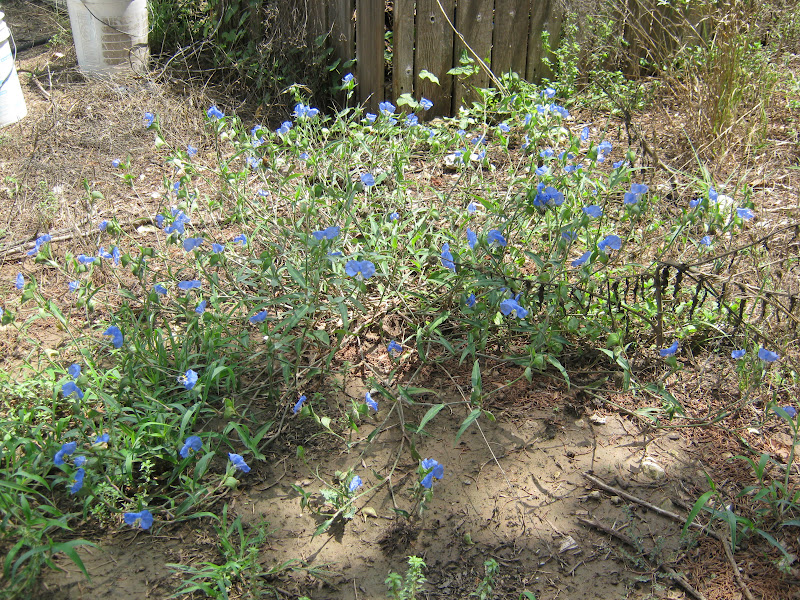
Day flowers have put on blooms again after rain.
We've had welcome rain on the hill this week. Over the past seven days, 4.2 inches of rain have fallen. More is falling right now!

The county commissioners instituted a burn ban on July 5 (after all the fireworks!), and the rains started three days later. Good job, commissioners!

This rain fell just in time to give plants a boost through to cooler weather. It was pretty durn hot and dry leading up to this week.

Petunia the hen leads her little flock to safety. See how ruffled up she is?
She does not like me so close. These chicks are a couple of weeks old.


In other news, we have three batches of chicks in the coop - the most we've ever had at one time. I can't explain this outburst of fecundity, but we are enjoying all the chicks.

The latest batch are miracle chicks. Petunia the hen had trouble this time around. She broke all of her first batch, then moved to a new nest. After a week or so there, she moved again, leaving eggs behind. My husband gathered the eggs and relocated them to the new nest. After five weeks, four chicks hatched successfully.

The second batch is shepherded by Gracie. Gracie was a perfectly mild-mannered hen (though while sitting she growled like a pteradactyl) who has turned ferocious after the hatch. She attacks anyone who gets too close to her five chicks. Now the family has figured out how to escape the outer sanctum, and they spend their days in the woods. One chick has disappeared so far. It's a jungle out there.

The oldest batch are still staying close their mother hen, Cream Cheese.
The oldest chicks, which are about three months old, have really interesting colors. Unfortunately, two of them appear to be roosters.

That's all the news from the hill this week. And that's the way it is.

Friday, January 27, 2012

Meat chickens - yea!


Last year I wrote about our first venture into raising meat chickens (read about it here). My daughter was grossed out ('70s expression!). Our chicken farmer friend refused to eat any of his flock, disgusted after watching them grow. Nonetheless, we decided to try again, using lessons learned.

This experience was more pleasant, albeit with one disturbing development.

First, we resolved never to raise Cornish Rocks again. They were bred for size, and as their size increased their brain size diminished. At least, that’s our theory. This time we ordered Red broilers, another type of meat chicken. The most important factor in this decision:  they are not white so the poop on their feathers would be camouflaged.

We took delivery of 25 chicks in October, ensuring they would reach maturity in the winter. The last batch suffered terribly in the heat of last May. They finally got so large they couldn’t move – and couldn’t reach water.

Moving Day!
With fewer chicks in the brood pen than last time, there was less fighting, plucking and pooping; we moved them into the chicken yard, a.k.a. Chicken Gitmo, at about two weeks.

This breed is much more appealing. When grown, the chickens were quite pretty. They did not get as large as the white ones, and so were able to move around freely. These were Einsteins compared to the last batch: these chickens knew how to scratch and find the pen at night.

The disgust factor was much lower this time around. Don't discount the importance of this.

Bandy and one of his lay-dies.
However, we had another problem. Our rooster, Bandy Bojangles, matured into a full-grown rooster at about the time the meat roosters did. He and a younger rooster, his son L’il, took to bullying the meat roosters. By processing time, Bandy had killed at least two, injured another, and forced us to send L’il to our neighbor’s chicken farm for his own protection. Bandy, the Godfather of Gitmo.

Due in part to the carnage of the mob wars, we ended up with around 20 birds to dress.

Our middle son helped with the processing of the first batch. I fully intended to help this time, as he was not available. However, once my husband began the unpleasant part (involving the innards – let’s say no more), he gave me a pass. He was afraid I would not be able to eat chicken afterwards. “Well, if you’re sure, honey,” I said, as I edged away from the kitchen. This has damaged my standing as a Pioneer Woman, but I think I can live with that.

So what do we think about home-grown chicken? It is tougher than store-bought meat. We plan to try brining one soon, to see if that tenderizes it.  I cannot tell a taste difference, but Dan says it tastes a little stronger to him, a little wilder than store-bought. (He has a more discerning palate in these matters.) These chickens have much larger drumsticks and smaller breasts – both of which suit our dining style.

Yes, we will continue raising our own meat chickens. Though we may have to bump off the Godfather.  Rub him out. He might end up sleeping with the fishes. But don’t tell him I said so. I’m a little afraid of him.

Favorite spot in the garden:

My favorite spot is right outside my window right now. Part of its charm is the movement of the Lindheimer's muhly (Muhlenbergia lindheimeri), so I've taken a movie to share instead of a static photo.


In case that doesn't work, which is entirely possible, here is that static photo:


Monday, December 5, 2011

Life on the frontier


Thursday, I was a pioneer woman.

Or at least as close to one as I’ll ever be.

First, I arose before daylight to get my daughter off to school. I usually poke up the fire in the woodstove at this point, but with pleasant weather we haven’t needed the heat. I prepared a nutritious breakfast (frozen waffle) and filled her lunch pail (a purple plaid insulated bag). We saddled up our ride (SUV) and rode off to school, eight miles away.

When I returned to the homestead, the chickens needed tending. Usually this is the husband’s job, but he was not available this day. I fed and watered them, then discovered a dead chicken in the coop. After examining it for cause of death – undetermined – I tossed it out in the woods. Returning to the coop, I gathered four brown and green eggs, and trudged back up the hill to the house.

Death is part of life here on the frontier. This chicken was one of our meat birds, however, so I was unhappy about losing the investment.

Next, I consulted with the well digger (more on that in a later post).

Time to bake bread! Can you see me, leaning over a floured board with sleeves rolled up, wearing a white apron, hair in a messy bun, sweat beading my brow as I vigorously knead dough? Oh wait, that wasn’t me. I made pumpkin bread – no kneading required.

My bones and rheumatism told me that rain followed by cold were imminent (those and the local weatherman), so I tied my bootlaces, left the bread baking and ventured forth to gather firewood. We don’t own a mule or horse, despite living in Texas. I really, really wish I could fashion a harness for Iris the dog to help drag loads. Short of these options, I was reduced to using the wheelbarrow. I did not have to cut or split the firewood (though I have wielded an ax before – scary, I know), just trundle my barrow out to the piles located here and there, load up, then return and stack logs on the wood rack.

At one point, logs and brush piles sited to slow water run-off distracted me. I moved a few logs around . . .

. . . only to arrive back at the house and find I had come perilously close to burning the bread.  I rescued it in the nick of time. Just a little burn smell tinged the pumpkin bread fragrance. It dissipated quickly. No one will notice.

Lunchtime. And naptime. And a Facebook check. What? Pioneer women didn’t have Facebook? Lord, they were deprived.

Next, I needed to plant vegetable seeds in the garden before the aforementioned rain fell.  I gathered my gloves and seed packets, collected one of my buckets of worm dirt, and followed the path to the vegetable garden. Usually this is my husband’s domain, also.  This day, Pioneer Woman was in charge.

I turned the soil, pulling out weeds and mixing in dried chicken poop and worm dirt. I carefully placed seeds for mixed lettuce greens, spinach, turnips and Swiss chard. I offered a benediction over the garden, something like this:  “Please grow. Rain’s coming. Good luck.”

In the middle of planting, I saddled the SUV again, retrieved my daughter from school and fed her a picnic supper, and delivered her to an evening commitment.

Final chore of the day was to prepare a home-cooked meal for my hard-working husband who had been out laboring in the fields all day. Or maybe he was riding on an airplane, returning from a business trip. On the menu:  turkey tenderloin topped with pecans, sautéed spinach and salad. Welcome home, honey!

My day of pioneering was fun. When I imagine doing all that and much, much more in a long skirt and bonnet, with no electric appliances, grocery stores, neighbors, gas-powered transportation or indoor bathrooms – jumpin’ Jehosaphat. I’m happy to be a pioneer woman on my own terms, assisted by modern conveniences.

Favorite spot in the garden:

A prior resident planted this Moses’ boat (Tradescantia spathacea, I think!) in small beds under trees, and they are flourishing with no attention from me. They have been doing well with our recent rains, but their days are numbered as surely a freeze is near.

Other names for this beauty are Moses-in-a-boat, Moses-in-a-basket, boatlily or oyster plant. According to Dave's Garden,  it is invasive in Florida, and contact with leaves can cause an allergic reaction.