Showing posts with label xeriscape. Show all posts

Sunday, September 22, 2013

First day of fall - let's plant!

Fall may be approaching.
This cactus had no label. It's actually
about 12 inches tall - looks huge here!


Don't get too excited. Don't put away the shorts and sandals just yet.

Last night we slept with windows open for the first time in three months. It was lovely.

Today, with birthday money in my pocket, my daughter and I stopped at our local nursery. I found a cool columnar cactus and a beautiful Buddleja or butterfly bush. She found the strangest little plant called a stone plant. She told her Dad later it looked like a troll's toe. It does.

This afternoon I spent time in my garden, doing some fall planting. I know that fall is the best time for planting in Central Texas. Unfortunately, I don't always do what is best. This extends to more than gardening. Hence the Friday night chocolate binges followed by Saturday morning migraines.

But I had new plants! And it was beautiful outside! So I planted.

I also piled up some topsoil in a mound and planted a desert willow given to me by my mother-in-law a few weeks back. It looks saddened by its sojourn in its pot, but I hope that it will perk up now that it has been permanently placed. I'm not showing you a picture of that - that's a blogger's privilege. We only have to show you what makes us look good.

This Buddleja did have an i.d. It was on the pot, which I promptly threw away.
Guess I'd better dig that out of the bin.

On another note, perhaps you have noticed it's been a long time since my last post. In July, I picked up a contract job that took a bit of time. A broken camera proved to be another obstacle to posting. I took the pictures here with my phone; the quality is, well, not good.

About a month ago, I started work full time with Texas Parks & Wildlife Department. I am working on web content for the state parks division, and I'm tickled pink.

Blogging will have to take a back seat to the paying job, but I will try to post occasionally.

Happy first day of fall!


Tuesday, February 12, 2013

Cool plant #1: Twist-leaf yucca


Today I bring to you the first in an occasional series on interesting plants endemic to my area, the Edwards Plateau located in Central to West Texas. What characterizes the Edwards Plateau? I’m so glad you asked! From the Texas Parks & Wildlife Department:

“The Edwards Plateau is an uplifted and elevated region originally formed from marine deposits of sandstone, limestone, shales, and dolomites 100 million years ago during the Cretaceous Period when this region was covered by an ocean. The western portion remains a relatively flat elevated plateau whereas the eastern portion known as the Hill Country is deeply eroded.”

We live in the Hill Country sector. What an odd idea, that we live in what was once an ocean. Proof is all around us, however, with sea creature fossils decorating many of the rocks we find – and we find lots of rocks here.

Our featured plant today is the twist-leaf yucca (Yucca rupicola). This is a cool little yucca with - you guessed it - twisty leaves! Its leaves are one to two feet long, with a colored margin, which can be light brown, yellow, orange, red or white (depending on the source consulted). Tiny sharp teeth march along those leaf margins and thin white curly hairs cover the leaf. The bloom stalk shoots up in the spring (April to June), and can be up to five feet tall, with large, heavily scented white or greenish white petals.

If you look closely, you can see the tiny teeth at leaf's edge. 
Also, notice yellow leaf margin on the upright leaf,
and red margin on leaf at bottom right.


And boy, is it tough. The twist-leaf yucca grows in full sun or part shade and on shallow rocky soil, is heat and drought tolerant, and is deer resistant (except for the blooms). Some years the deer leave the yuccas alone, but when food is scarce they will top them all. This is a sad sight to a gardener, but part of the natural cycle, after all.

These yuccas grow fairly commonly on our property. One has popped up in a flowerbed.  This could be an unwelcome addition, but the plant only gets up to two feet in size and is manageable in its volunteer location.

If you live in the Hill Country, I hope you have some of these neat plants growing on your property. If you don’t, maybe you can find one at a native plant nursery.

Favorite spot in the garden:

Well, I haven’t added this feature lately, but today I have such a spot. This area is outside the living room French doors, and catches the sun so prettily (though it is cloudy today). Newly planted snowdrops (Leucojum aestivum from my mother-in-law's grandmother's house) surround the area, with rich purple oxalis (Oxalis triangularis) and wandering Jew (Tradescantia pallida, I think) in the middle, backed by a lush spread of yarrow (Achillea millefolium).  I love this color combination!


Monday, December 31, 2012

Rounding up the year - garden projects completed.

Can't wait to see if cleaning and amending
the iris bed pays off with spring blooms!

It is gray, foggy and drizzly outside, and a cool 58 degrees: perfect weather for reflecting on garden accomplishments of the past year. 

Nearly a year ago, I posted about my garden plans for the year 2012. Four projects were on my list, some in varying states of completion.

You know how these New Year’s Resolution lists are. Generally they end up making one feeling inadequate, lazy or incompetent. Take your pick.


I blogged about the completion of this project in September, You just can't rush these things.
I am pleased to post, however, that I actually completed every project on my list.

This is probably the first time in my entire life that a New Year’s Resolution list has been fulfilled completely. If I had known this would be such a successful list, I could have added additional, important items to it:  GET A JOB  (oops, sorry, did not mean to shout that), finish a cross-stitch project (underway since at least 2010), write a novel.

Completed rock garden out front;
apparently I never blogged about this!

More of the rock garden, which extends
across the front yard and parking area.

Bed populated with blue mistflower. If you are familiar with this plant,
you know that it will fill in the bare spaces very quickly!

Perhaps it is best to keep the list small and manageable.

I hope you were equally productive with your projects. Even if you weren’t, I hope you had a wonderful time dreaming about your projects and spending time in your garden. After all, that is the most rewarding part of gardening, is it not?


Tuesday, December 11, 2012

Where's the rain?


It's a good thing to have drought-tolerant plants
when you garden in a drought-prone area:  Silver pony-foot
(Dichondra argentea) under Lindheimer's muhly
(Muhlenbergia lindheimeri), with spineless prickly pear
(Opuntia ellisiana, maybe).

We just wrapped up a November totally devoid of measurable rain. I can’t find any records for Hays County, but in Austin where they track such things the last dry November was in 1897.

As you know, this part of the country recently endured an extreme case of the dries during the summer of 2011, culminating in the terrible fire near Bastrop. The next summer and fall were reasonably wet. We gardeners were ecstatic! Probably the farmers and ranchers were pretty happy, too.

But anyone who has even a passing acquaintance with history (which accurately describes my acquaintance) knows that droughts can be multi-year events. The drought of record in Texas happened in the ‘50s, and lasted seven to 10 years (depending on the source). And when you see a factoid like this – the last dry November was 115 years ago – well, your heart sinks a little.

I read somewhere (and now can't remember where) that when very thirsty, the Agave americana's leaves start opening wider. These are pretty wide.

According to the U.S. Drought Portal, 82 percent of Texas is in moderate to extreme drought as of Dec. 4. Hays County is in the “moderate drought” category. To my recollection, we have been categorized in some drought category or other since 2011.

The Keetch-Byram Drought Index measures forest fire potential on a scale of 0 (saturated soil) to 800 (completely dry soil). The majority of Texas counties, including Hays County, appear to be in the 500-600 level.

I may have posted this before, but I still find it fascinating so here it is again: an animation of the drought index:  http://www.youtube.com/watch?v=58S0cmdfoKg.

I’m not a meteorologist, nor do I play one on television, but I’m beginning to wonder if drought is just Texas’ natural condition in the brave new world of climate change.

Days with 20%, 30% and 40% chances of rain continue pass by dry. Seems like there’s a good chance this drought is not through with us.

Favorite spot in the garden:  The white crape myrtle behind my porch swing is at last bowing to the season, and losing its leaves. The fall color of its leaves, decorating the tree and the ground underneath, really accentuate the red of its trunk.

Monday, October 29, 2012

Crazy beautiful


Mealy blue sage (Salvia farinacea)
We are experiencing a crazy beautiful fall, with perfect temperatures and rain at appropriate intervals. Maximilian sunflowers, palafoxia, broomweed and asters are decorating the roadsides.  

Here on the hill, my flowers are looking pretty spiffy, too. In fact, things look about as good here as they ever get, so I thought I would share some pictures.


Four-nerve daisies (Tetraneuris scaposa)
in front, Gregg's mistflower (Conoclinum 
greggii) behind.

Fall and spring are the best gardening seasons in Central Texas. The rain and the temperatures are moderate . . .  except when they're not. Trees have not started losing leaves yet, but the first good front arrived over the weekend, and we've been in the lower 40s for the past several nights. We’re sure to see some fall color soon!

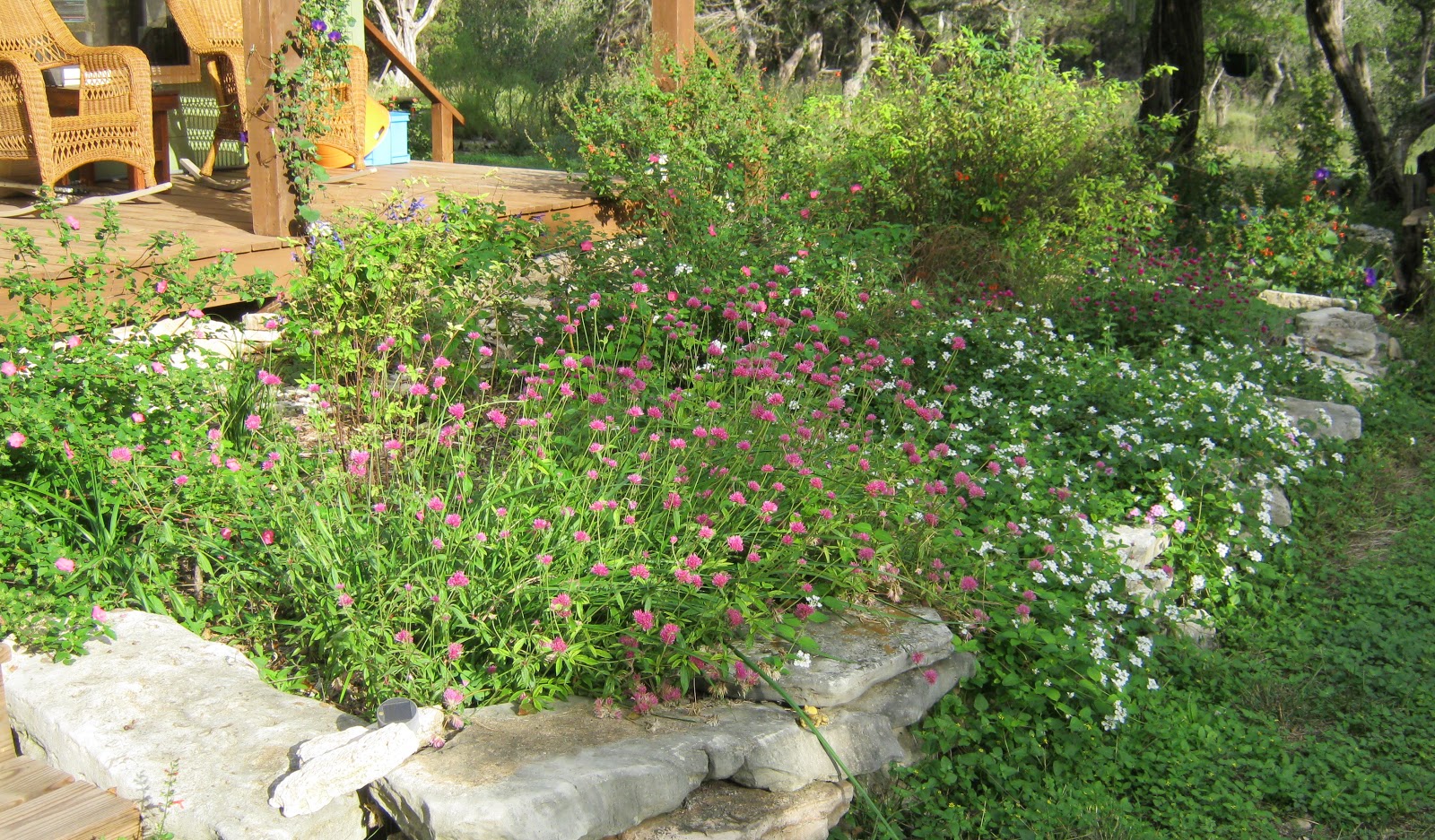
My pride and joy right now is the east bed. I envisioned this as a cottage bed, overflowing with blooms of less xeric plants since it gets afternoon shade and has deeper soil.  Well, the shade is late in the day arriving and I am not willing/able to water as much as cottage plants desire. You may recall that one year this area suffered chicken depredations, and Iris the dog periodically decides she must excavate immediately and deeply. This bed has never lived up to my expectations.

Until now.

East bed! From left:  rock rose (Pavonia lasiopetala), Gomphrena globosa 'Fireworks,'
white and purple trailing lantana (Lantana montevidensis), bachelor buttons (Gomphrena globosa),
purple morning glories. Black and blue salvia (Salvia guaranitca 'Black and Blue')
and some sort of gaura ('Whirling Butterflies'?) are in the back.
I believe I have finally come up with a good combination of flowering plants that can withstand the heat and moisture conditions, yet still give me the cottage feel I wanted for this area. Hurrah!

The next frontier: blackfoot daisies (Melampodium leucanthum), rock rose and fall aster
(Symphyotrichum oblongifolium, I think) with a volunteer Lindheimer muhly (Muhlembergia linheimeri).
Many flame acanthus (Anisicantus quadrifidus var. wrightii) grow here, also, but aren't blooming now.

My new pond, with turk's cap (Malvaviscus 
arboreus var. drummondii). Do you see
the goldfish and happy water plant?

Looking out my window, I have identified the next frontier. Out front is a wild area, where we do not mow. I’ve planted a few things, and a few others have self-sowed. There is such a profusion of blooms that I’ve decided to take it to the next level, cleaning out weeds and grass so those volunteers can spread and thrive.

There’s nothing better than a new garden area to plan. That’s what beautiful weather and conditions will do to a gardener – provide inspiration for the next project!


Rock rose, black dalea (Dalea frutescens), yucca,
and autumn sage behind.


From the left, zexmenia (Wedelia texana), pigeonberry (Rivina humilis), white mistflower
(Ageratina havanensis - behind about to burst into bloom), fall aster, dayflower (Commelina erecta),
bamboo muhly (Muhlenbergia dumosa), and more zexmenia.

I hope you are enjoying a crazy beautiful fall in your garden!


Friday, September 21, 2012

Oxblood lilies arise


Hear ye, hear ye, the first rain of fall has . . . fallen. After that first rain (in late August or September) the loveliest thing happens in my garden – the oxblood lilies arise from the mud! Of course the rain lilies bloom, also – though sparsely this time, perhaps due to tough summer conditions.

Inspired by these lovelies, I chose to write a lily post. Perhaps I could wax poetic about the graceful, nodding flowers atop long slender stalks, and refer to lily lore – such as how lilies have symbolized “purity, innocence and goodness” (Chicago Tribune, Sept. 18, 1988) from the times of the ancient Greeks and Romans, and continuing to this day in Christianity. Perhaps I would mention famous people named Lily, though I could only come up with Lily Tomlin. I could trot out famous expressions, such as “gilding the lily.”

I googled oxblood lilies, to begin learning about this beautiful flower, and made a crushing discovery.

Oxblood lilies are not lilies. (Rain lilies are, however.)

What cruel trick is this? This derails the whole theme of my post! Who can I complain to? Who is responsible for this travesty in plant taxonomy!

Oxblood lilies (Rhodophiala bifida), also called schoolhouse lilies, are members of the Amaryllis family.  According to The Southern Bulb Company, German settlers introduced this Argentinean native to central Texas.

My mother-in-law dug these bulbs from the front yard of her grandparents’ house, and years later passed some along to me. Her grandparents, Emil and Laura Brune, ran Pearfield Nursery in Colorado County. Laura’s father, German immigrant J.F. Leyendecker, established Pearfield in 1876.  According to my mother-in-law, Peter Heinrich Oberwetter, a German Texan who studied bulbs, introduced oxblood lilies to Texas about 1900.

“Whether or not J.F. Leyendecker had them, I can't say for sure, but Grandma always had them,” says Mary Anne. “They used to line her front walk, which is why I planted mine out in the front.”
This group of lilies is by my front step.

I love how these lilies surprise me each fall. After they bloom, the foliage grows during the winter, and then dies back with the heat. By the time they bloom in the fall, I have forgotten they even exist. These babies are tough - drought tolerant, soil tolerant, preferring part shade to full sun. Apparently they don’t require dividing, but can be after the foliage dies back. The blooms proliferate over the years.

This is probably an evening star rain lily (Cooperia 
drummondii). You may remember my earlier post
about rain lily identification issues.

They did not bloom at all during last year’s drought. Perhaps a gardener could be forgiven for thinking they had died.  But the fall rain resurrected them, and they are more beautiful this year than ever before.

Here’s to oxblood not-lilies!

Favorite spot in the garden:

See above!

Wednesday, January 18, 2012

Hope springs eternal.


The weather has been nice on the hill, and when that happens, a gardener’s fancy lightly turns to thoughts of new gardens (apologies to Alfred, Lord Tennyson). Several projects are on my list of 2012 objectives. The plan is to publish this list and thereby apply pressure to achieve said objectives.

The parking area is behind me, and the path goes up the right side.
For me, creating new gardens is much more exciting than maintaining old ones. This does not bode well for the condition of my existing flowerbeds, but it’s fact. Right now I am afire with enthusiasm for a new, ambitious undertaking.

I am working on the bones for a rock garden in front of the house. Visitors will pass through this garden on an existing stone path. I’m convinced the bed will take my yard and garden to a new level of sophistication and interest. (This type of thinking undoubtedly signals disaster)

Rock moved carefully by my son, with rain lilies
sprouting from dirt in the crevice.


Currently, I am in the rock selecting, digging, hauling and arranging phase. I roped my oldest son into moving two large rocks; the rest will be smaller. One day, when standing back to gain perspective, I saw that this garden could be expanded into a larger area that would tie in with existing landscaping. This will be so cool! (Cue “uh-ohs” from the audience.)

Even if it doesn’t turn out quite like I envision, I am having great fun working on it.

It will be pretty, it will!
Objective number two is halfway done. Last fall my husband and I laid rock framework for a long-planned bed under the living room window. The bed will be raised nearly two feet and will feature Turk’s cap and a vine of some sort. Two years ago I jumped the gun and bought a water container; the pump to make it tinkle sits on a laundry room shelf. The vine will grow on a rusty  structure that prior tenants used for outdoor showers. Now all we need is dirt - lots of dirt.

Objective number three is the easiest by far. My iris bed is looking oh so lovely right now after fall rains. The plan is to add garden soil and build up the rock border. Weeding is required. Also, my neighbor (thanks, Sheri) gave me a variety of iris bulbs awhile back that are lurking in a box on my porch. By awhile back, I mean several years. My daughter laughed at me when I mentioned these relics. They are most likely dead, but you just never know.

Fourth objective calls for transplanting blue mistflower seedlings to a completed bed that remains barren after seeds failed to sprout in the drought.

All of this is proposed with the understanding that I cannot water at all, as the drought is expected to last through the spring and our well is showing signs of stress.

Ah, hope springs eternal.

Wednesday, November 16, 2011

Fall blooms on the hill

The woolly butterflybush (Buddleja 
marrubiifolia) is a Texas native, according to the 
Wildflower Research Center. This cool plant 
survived the summer in my hottest bed 
without supplemental water. It grows 3 to 
6 feet tall (mine is about 3) and 
attracts butterflies, as its name implies.
As per usual, I am posting for Garden Bloggers Bloom Day, hosted by May Dreams Gardens one day late. In my defense, it was raining yesterday. While we were thrilled by the 1 inch we received, my camera was not and took the day off. That inch of rain brings us to 15.1 inches for the year (our average is about 33 inches). It's astonishing anything is blooming at all. But voila!

We are having a beautiful fall in central Texas. The temperatures have been mostly in the upper 70s during the day, 50s and 60s at night, with a few quick cool spells. This moderate weather is probably drought related, but I'll take it. Monday evening, I was out in shorts and t-shirt. I'm so happy to live in Texas right now! (I might not have been so happy at the end of this past summer.)

Also, we have not had a freeze yet here on the hill, though some of our neighbors have. Our lowest temp so far has been 37 F.


Here's another Texas native perennial strutting its stuff. The white mistflower
(Ageratina havanensis) is a butterfly magnet, though it hasn't drawn many this year.
However, the bees were ecstatic this morning! Again, from the Wildflower Center,
this is a Texas native, found on the Edwards Plateau south to Mexico,
blooming in October and November. 


Above: Moses' boat, bedraggled,
but hanging in there!
Left:  Tropical sage (Salvia coccinea)
is a southern U.S. native. It suffers in
drought here, but perks up nicely with rain.


Fleabane! This stuff volunteers - I love it!

Still blooming - new gold lantana  . . .
These blackfoot daisies (Melampodium leucanthum) reappeared after our fall rains.
Last, but not least, flame acanthus (Anisacanthus quadrifidus var. wrightii)
is still blooming and nourishing lots of bees. I tried to get a picture of a bee dining,
but the darn things would not pose.


Thursday, November 3, 2011

Purple sage memories


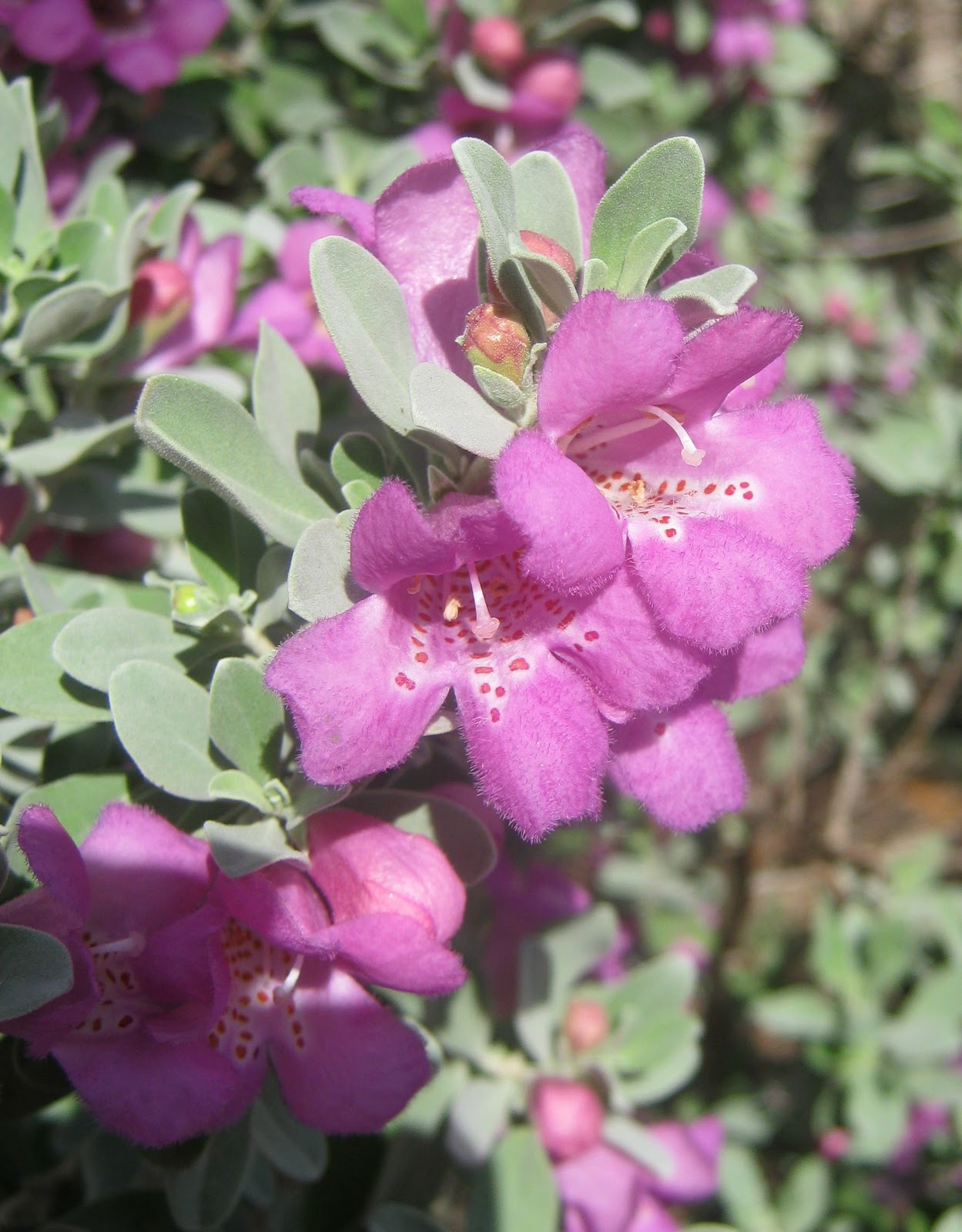
Enlarge this if you can to see the tiny hairs
covering the leaves and flower petals.
Every gardener knows that gardening is a way of preserving memories. Each of us has memories associating certain plants with beloved people and places. Gardeners preserve those memories with their plant choices.

I was reminded of a memory last week when my cenizo or purple sage (Leucophyllum frutescens) burst into bloom two weeks after recent rain.

When I entered first grade, we lived in Kermit, Texas, truly one of the state’s armpits. As I recall, it was hot, dry and dusty. Periodically dust storms would attack. Its only reason for being, as far as I could tell, was to provide my father with employment in the oil “bidness.” (We left this town after my fourth grade year, so it may not be as bad as my fourth-grade self remembers.)

But one good memory remains. I started school at Purple Sage Elementary there. I turned 7 the week after first grade began (I skipped kindergarten). I was ready to learn. Even though school has its social challenges for nerds like me, the educational challenges were mostly enjoyable. I liked school; I was good at it.

In my mind’s eye I can see a row of purple sages planted across the front of that school, brightened with lavender blooms after a rare West Texas rain.  Perhaps I associate purple sages with the advent of a new phase in my life – away from home, mother and sisters; out in the big world; in an arena in which I would be successful. I have had a soft spot for these shrubs ever since.

When we moved to the hill, my father drove up soon after wagging a cenizo dug out of his yard in North Texas, where conditions weren’t quite right. I was not ready to landscape yet, so it sat in a pot for over a year.


I finally found a spot out front in a xeric bed, semi-shaded by live oaks, tucked behind an already established yucca.  In it went, and on it has dwelled since. In this summer’s drought, its bones were showing. However, it survived the summer without supplemental water and is now blooming beautifully.

Cenizo is a southwest Texas native according to the Wildflower Research Center. It needs good drainage, likes limestone, is evergreen, blooms after rain (giving rise to another of its names – Texas barometer bush), provides nectar for butterflies and insects, survives drought and heat, and does not appeal to deer.

I have not seen any cenizos in the wild in my area, but it seems quite happy here. I’d better plant more!

Favorite spot in the garden:

I actually have three favorite places right now, but that’s not fair. I have to choose.  So I choose – this patch of new gold lantana (Lantana x hybrida ‘New Gold’). By happenstance, these three plants were put in exactly the right spot five years ago, and they have done exceedingly well. This year they have not bloomed much, but with the recent rain they have made up for lost time. Unfortunately, we may get a freeze overnight, so their glory may be short-lived. Long live the lantanas!

Thursday, October 13, 2011

Summer survivors


As we all know, it was a tough year for gardens in the southwest. Garden bloggers wrote repeatedly about the need to rethink the garden. In that vein, this post is dedicated to noting the plants in my garden that did pretty well this summer, despite the record-breaking heat and drought.

Spineless prickly pear (Opuntia ellisiana),
 Lindheimer's muhly (Muhlenbergia lindheimeri
and silver ponyfoot (Dichondra argentea).
These were watered occasionally late in the summer.

I had originally thought to do a post on the casualties of the drought, complete with teenage moaning and woe-is-me-ing. I have actually spent a good bit of the summer in this mode, despite the fact that I haven’t been a teenager in many years. Many, many years.

But as a mom, I have learned to embrace the power of a positive attitude. I can carry that into the garden, I can. Even though I lost so many plants, so many . . . little . . . plants . . .  No, stop.

Onward with positivity.

Meteorologists say this drought could continue for years, so rethinking the garden is not just an idle exercise. Frankly, I wasted quite a bit of money this year on new plants that did not survive. I also wasted quite a lot of well water trying to keep said plants alive.

Anacacho orchid tree (Bauhinia lunarioides).
This did receive some supplemental water late
in the summer, but I think it might have survived
without.
I need to be smarter and more disciplined about plant choices.  To me, gardening in its highest, most successful form involves choosing plants appropriate for the site and climate. I thought I was doing that, but as Dylan sings, “for the times they are a-changin'.”

P.S. I would really love to see other Texas gardeners’ survivor lists, so that we could compare notes and maybe come up with new plant options. If you have such a list, add your list or post a link in my comments. Thanks!


No supplemental water at all! On the left, purple sage (Leucophyllum frutescens), 
and on the right, the indomitable century plant (Agave americana - I think - it was a pass-along plant).

Autumn sage (Salvia greggii) in the back. In front is a black dalea (Dalea frutescens) -
a native wildflower. The sages show heat stress, but bounce right back with water.
The dalea just got a little thin. 

Newly planted, regularly watered, but showed little sign 
of heat stress. This is yellow bells or esperanza 
(Tecoma stans).  It will get much larger and have showy 
yellow blooms - I can't wait!
That's right - Texas lantana 
(Lantana urticoides). 
It did receive occasional water 
late in the summer.
This trailing lantana (Lantana motevidensis 'Alba') was transplanted at the beginning of this horrendous summer, and soldiered through.
(Yes, I watered it - but plenty of things I watered did not survive!)

This is not prepossessing, I realize. This Mexican bird of paradise (Caesalpinia mexicana) was purchased this spring at Peckerwood Gardens and planted upon my return home. It sat all summer with occasional watering and did fine. I was so proud! But when I went out to take a picture for this post, after 2.8" of rain last weekend - wahh! The top appears to be gone, but it has new growth at the bottom. I read that it requires good drainage - perhaps it got too much water.

Oh yes, my friends, the flame acanthus (Anisacanthus quadrifidus var. wrightii)  is a keeper . . .
The Mexican oregano (Lippia graveolens)
is not blooming now (old picture),
but it did survive all summer
with only roof run-off.  The new one planted
 out front did not survive.
. . . as is the pavonia (Pavonia 
lasiopetala) a.k.a. rock rose.
This was the only plant that
bloomed all summer, 
off and on.