Showing posts with label fall. Show all posts

Sunday, September 22, 2013

First day of fall - let's plant!

Fall may be approaching.
This cactus had no label. It's actually
about 12 inches tall - looks huge here!


Don't get too excited. Don't put away the shorts and sandals just yet.

Last night we slept with windows open for the first time in three months. It was lovely.

Today, with birthday money in my pocket, my daughter and I stopped at our local nursery. I found a cool columnar cactus and a beautiful Buddleja or butterfly bush. She found the strangest little plant called a stone plant. She told her Dad later it looked like a troll's toe. It does.

This afternoon I spent time in my garden, doing some fall planting. I know that fall is the best time for planting in Central Texas. Unfortunately, I don't always do what is best. This extends to more than gardening. Hence the Friday night chocolate binges followed by Saturday morning migraines.

But I had new plants! And it was beautiful outside! So I planted.

I also piled up some topsoil in a mound and planted a desert willow given to me by my mother-in-law a few weeks back. It looks saddened by its sojourn in its pot, but I hope that it will perk up now that it has been permanently placed. I'm not showing you a picture of that - that's a blogger's privilege. We only have to show you what makes us look good.

This Buddleja did have an i.d. It was on the pot, which I promptly threw away.
Guess I'd better dig that out of the bin.

On another note, perhaps you have noticed it's been a long time since my last post. In July, I picked up a contract job that took a bit of time. A broken camera proved to be another obstacle to posting. I took the pictures here with my phone; the quality is, well, not good.

About a month ago, I started work full time with Texas Parks & Wildlife Department. I am working on web content for the state parks division, and I'm tickled pink.

Blogging will have to take a back seat to the paying job, but I will try to post occasionally.

Happy first day of fall!


Tuesday, December 11, 2012

Where's the rain?


It's a good thing to have drought-tolerant plants
when you garden in a drought-prone area:  Silver pony-foot
(Dichondra argentea) under Lindheimer's muhly
(Muhlenbergia lindheimeri), with spineless prickly pear
(Opuntia ellisiana, maybe).

We just wrapped up a November totally devoid of measurable rain. I can’t find any records for Hays County, but in Austin where they track such things the last dry November was in 1897.

As you know, this part of the country recently endured an extreme case of the dries during the summer of 2011, culminating in the terrible fire near Bastrop. The next summer and fall were reasonably wet. We gardeners were ecstatic! Probably the farmers and ranchers were pretty happy, too.

But anyone who has even a passing acquaintance with history (which accurately describes my acquaintance) knows that droughts can be multi-year events. The drought of record in Texas happened in the ‘50s, and lasted seven to 10 years (depending on the source). And when you see a factoid like this – the last dry November was 115 years ago – well, your heart sinks a little.

I read somewhere (and now can't remember where) that when very thirsty, the Agave americana's leaves start opening wider. These are pretty wide.

According to the U.S. Drought Portal, 82 percent of Texas is in moderate to extreme drought as of Dec. 4. Hays County is in the “moderate drought” category. To my recollection, we have been categorized in some drought category or other since 2011.

The Keetch-Byram Drought Index measures forest fire potential on a scale of 0 (saturated soil) to 800 (completely dry soil). The majority of Texas counties, including Hays County, appear to be in the 500-600 level.

I may have posted this before, but I still find it fascinating so here it is again: an animation of the drought index:  http://www.youtube.com/watch?v=58S0cmdfoKg.

I’m not a meteorologist, nor do I play one on television, but I’m beginning to wonder if drought is just Texas’ natural condition in the brave new world of climate change.

Days with 20%, 30% and 40% chances of rain continue pass by dry. Seems like there’s a good chance this drought is not through with us.

Favorite spot in the garden:  The white crape myrtle behind my porch swing is at last bowing to the season, and losing its leaves. The fall color of its leaves, decorating the tree and the ground underneath, really accentuate the red of its trunk.

Monday, November 26, 2012

What is going on around here?

Something is going on around here. I'm not sure what it is. Something is different. Hmmm.

Flame-leaf sumac (Rhus lanceolata) is - well - flaming.
Fall-blooming Copper Canyon daisy
(Tagetes lemmonii)
Let me lay out the clues for you.

Strange colors have appeared out in the yard and woods. The normal greens have been interrupted by occasional oranges and yellows. Very odd.

The wicker rockers have disappeared from the porch. I've so enjoyed rocking in those chairs these past few months - feeling balmy breezes on my bare arms while gazing out at my colorful domain. The rockers have been replaced by a wood rack half-stocked with oak and cedar logs. This is not near as comfortable for domain gazing. Sort of knobbly. Strange.


My laundry has become bulkier, recently populated by sweatshirts and blue jeans, instead of t-shirts and shorts. Bizarre.

Here's the real kicker: it is cooler outside than it is inside. I know! What the h-e-double-l is transpiring here on the hill?

What? Fall? You mean, autumn? That elusive season that sometimes appears after the marathon that is summer in Texas, and before the sprint that is winter?

Oh.

Never mind.

Little bluestem (Schizachyrium scoparium)
is going to seed.


Thursday, November 8, 2012

Fall beauties.


The white mistflower (Agaratina havanensis) is blooming in my garden, in a profusion not seen here before. The mistflower is native from Central Texas south into Mexico. In and of itself, it is beautiful when in bloom. But when butterflies flutter all around it, drawn by its heady fragrance wafting on a breeze . . . well, it becomes sublime.


Red admiral (Vanessa atalanta)
is the most common visitor.
I've never seen this butterfly here before;
it is a bordered patch (Chlosyne lacinia 
adjutrix). The adjutrix  is a Texas subspecies.


I have spent time the past two days sitting on a pile of rocks next to this bush with camera in hand. I can’t really describe how fabulous this is: perched two feet away from buzzing bees and fluttering butterflies, including some new-to-me types, all so intent on this little bush with its multitude of tiny white blooms that they quickly forget I am here.  They are busy harvesting the last nectar of the year before cooler weather arrives.

Queens (Danaus gilippus) are frequent visitors on our blue mistflower; guess they like this, too!
This was one of those transcendent natural experiences.

Well, I'm not sure but I think
this is an American painted lady
(Vanessa virginiensis).

The Texan crescent (Anthanassa 
texana) is new to me, also.

Have you ever had one of those experiences? While outside somewhere, you happen upon something so cool, so beautiful, so interesting that you will never forget it? For me, it usually happens when it is very quiet and I am alone.

Twenty years ago we lived in the middle of a 10-acre hay pasture. Bluebonnets covered the pasture in the spring; it was absolutely beautiful. One quiet day in early summer I stepped outside and heard the oddest popping sounds all around me. I stopped and looked around, trying to determine the origin of the sounds. I saw nothing, but quickly realized that I was hearing bluebonnet seedpods popping open all over the pasture. I stood there listening with a big grin on my face, looking over the pasture in amazement. Yes, I still remember that moment.

My first i.d. of this one, too:  pearl crescent (Phyciodes tharos).
This tattered fellow appears
to be a variegated fritillary
(Euptoieta claudia).


This memory of communing with and observing butterflies on the mistflower will stay with me, also. When I’m looking out the window on a cold gray winter day, wishing for summer, I will unpack this memory, and relive those joyous moments, sitting with butterflies under a warm November sun.

Monday, October 29, 2012

Crazy beautiful


Mealy blue sage (Salvia farinacea)
We are experiencing a crazy beautiful fall, with perfect temperatures and rain at appropriate intervals. Maximilian sunflowers, palafoxia, broomweed and asters are decorating the roadsides.  

Here on the hill, my flowers are looking pretty spiffy, too. In fact, things look about as good here as they ever get, so I thought I would share some pictures.


Four-nerve daisies (Tetraneuris scaposa)
in front, Gregg's mistflower (Conoclinum 
greggii) behind.

Fall and spring are the best gardening seasons in Central Texas. The rain and the temperatures are moderate . . .  except when they're not. Trees have not started losing leaves yet, but the first good front arrived over the weekend, and we've been in the lower 40s for the past several nights. We’re sure to see some fall color soon!

My pride and joy right now is the east bed. I envisioned this as a cottage bed, overflowing with blooms of less xeric plants since it gets afternoon shade and has deeper soil.  Well, the shade is late in the day arriving and I am not willing/able to water as much as cottage plants desire. You may recall that one year this area suffered chicken depredations, and Iris the dog periodically decides she must excavate immediately and deeply. This bed has never lived up to my expectations.

Until now.

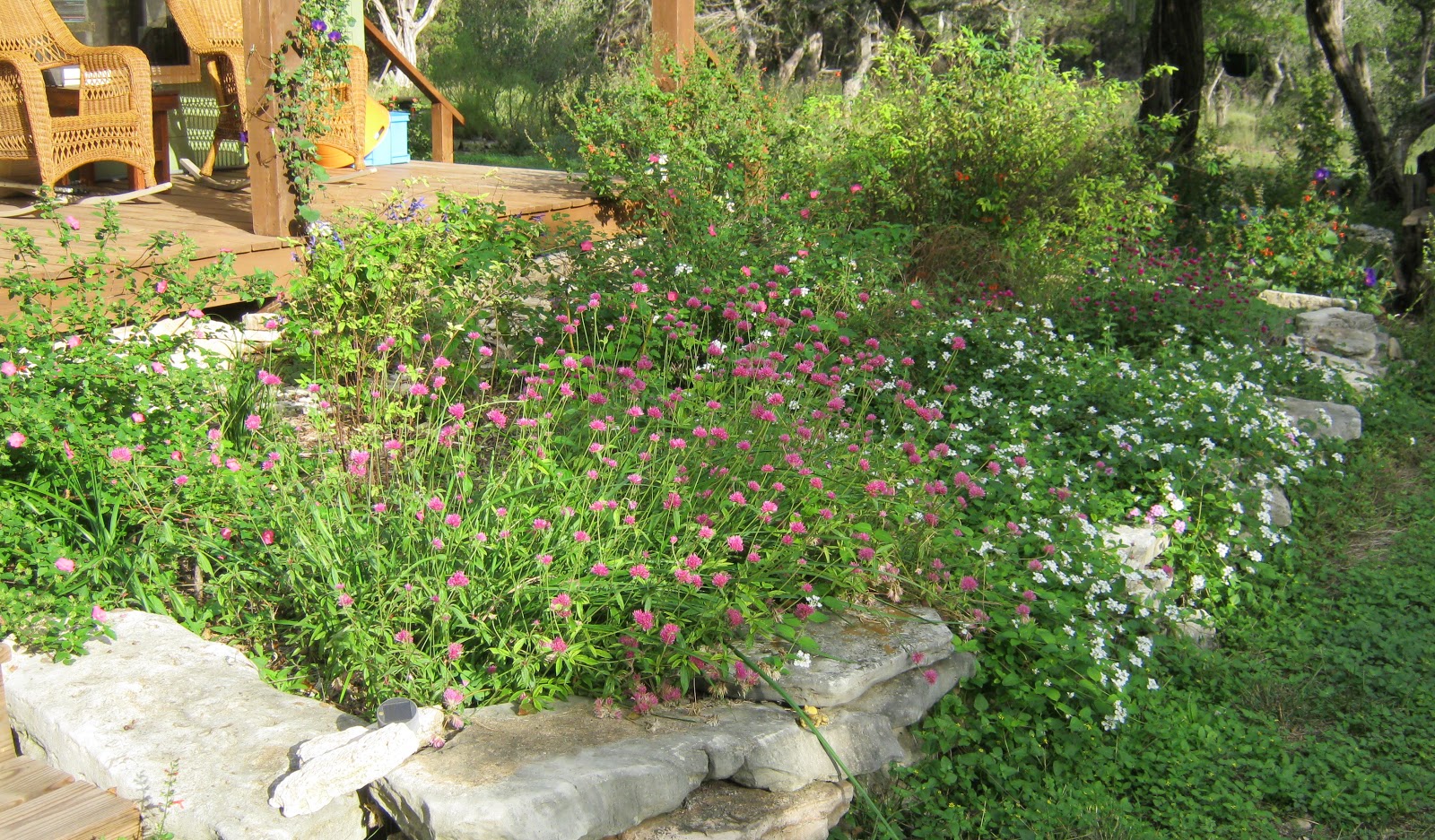
East bed! From left:  rock rose (Pavonia lasiopetala), Gomphrena globosa 'Fireworks,'
white and purple trailing lantana (Lantana montevidensis), bachelor buttons (Gomphrena globosa),
purple morning glories. Black and blue salvia (Salvia guaranitca 'Black and Blue')
and some sort of gaura ('Whirling Butterflies'?) are in the back.
I believe I have finally come up with a good combination of flowering plants that can withstand the heat and moisture conditions, yet still give me the cottage feel I wanted for this area. Hurrah!

The next frontier: blackfoot daisies (Melampodium leucanthum), rock rose and fall aster
(Symphyotrichum oblongifolium, I think) with a volunteer Lindheimer muhly (Muhlembergia linheimeri).
Many flame acanthus (Anisicantus quadrifidus var. wrightii) grow here, also, but aren't blooming now.

My new pond, with turk's cap (Malvaviscus 
arboreus var. drummondii). Do you see
the goldfish and happy water plant?

Looking out my window, I have identified the next frontier. Out front is a wild area, where we do not mow. I’ve planted a few things, and a few others have self-sowed. There is such a profusion of blooms that I’ve decided to take it to the next level, cleaning out weeds and grass so those volunteers can spread and thrive.

There’s nothing better than a new garden area to plan. That’s what beautiful weather and conditions will do to a gardener – provide inspiration for the next project!


Rock rose, black dalea (Dalea frutescens), yucca,
and autumn sage behind.


From the left, zexmenia (Wedelia texana), pigeonberry (Rivina humilis), white mistflower
(Ageratina havanensis - behind about to burst into bloom), fall aster, dayflower (Commelina erecta),
bamboo muhly (Muhlenbergia dumosa), and more zexmenia.

I hope you are enjoying a crazy beautiful fall in your garden!


Wednesday, September 26, 2012

Fall flowers spring forth!


Wildflower Wednesday, hosted by Gail at clay and limestone, gives me the opportunity to showcase a few blooms on the hill today. Thanks to September rains, we do have some wildflowers in bloom.

All the wildflowers I found today have very small flowers. None are showy, except perhaps in masses. These are the hardy survivors. They have persevered through the heat and through the drought.  Now, in their quiet, understated fashion, they lend subdued color to the fall season.

One of our favorite fall wildflowers has poked its blooms above the mulch – the wood-sorrel (Oxalis drummondii).  This beauty likes dry or moist soil, grows in sun or part shade, and forms small colonies in open grassy areas, open woodlands, and brushy areas on calcareous or sandy soils. It is native to Texas, New Mexico and Arizona.  Its leaves resemble clover, and the flowers fold down at dusk and in cloudy weather. While its color is bright, its habit and size mean one must look closely to find it among dried grasses and leaf litter.

White heliotrope is an understory plant here to the broomweed
Of course, the white heliotrope (Heliotropium tenellum) continues to bloom, as it has for most of the summer.

The broomweed (Amphiachyris dracunculoides) has begun blooming. These are about three feet tall, with a bushy habit. These are not at all specific to Texas, but are plentiful here. According to Wildflowers of Texas (Ajilvsgi), early settlers tied the plants to sticks and used them as brooms. Hmm, sounds like a fun thing to try with my daughter . . . 

I also found a mystery flower. The plant is small, with insignificant flowers. Upon closer inspection, and with the use of a camera, one discovers the beauty of those insignificant flowers, which feature sky blue anthers. I cannot find it in my books, so if anyone has a clue what this is – share it with me!

Favorite spot in the garden:

Everything across the front of this bed is blooming at one time! (Don’t look at the stuff behind, none of which is blooming.) From left to right, Gomphrena globosa ‘Fireworks’, remains of some oxblood lily blooms (Rhodophiala bifida), white and purple trailing lantana (Lantana montevidensis), bachelor buttons (Gomphrena globosa), and some stray purple morning glories and tropical sages (Salvia coccinea).