Showing posts with label memories. Show all posts

Thursday, November 8, 2012

Fall beauties.


The white mistflower (Agaratina havanensis) is blooming in my garden, in a profusion not seen here before. The mistflower is native from Central Texas south into Mexico. In and of itself, it is beautiful when in bloom. But when butterflies flutter all around it, drawn by its heady fragrance wafting on a breeze . . . well, it becomes sublime.


Red admiral (Vanessa atalanta)
is the most common visitor.
I've never seen this butterfly here before;
it is a bordered patch (Chlosyne lacinia 
adjutrix). The adjutrix  is a Texas subspecies.


I have spent time the past two days sitting on a pile of rocks next to this bush with camera in hand. I can’t really describe how fabulous this is: perched two feet away from buzzing bees and fluttering butterflies, including some new-to-me types, all so intent on this little bush with its multitude of tiny white blooms that they quickly forget I am here.  They are busy harvesting the last nectar of the year before cooler weather arrives.

Queens (Danaus gilippus) are frequent visitors on our blue mistflower; guess they like this, too!
This was one of those transcendent natural experiences.

Well, I'm not sure but I think
this is an American painted lady
(Vanessa virginiensis).

The Texan crescent (Anthanassa 
texana) is new to me, also.

Have you ever had one of those experiences? While outside somewhere, you happen upon something so cool, so beautiful, so interesting that you will never forget it? For me, it usually happens when it is very quiet and I am alone.

Twenty years ago we lived in the middle of a 10-acre hay pasture. Bluebonnets covered the pasture in the spring; it was absolutely beautiful. One quiet day in early summer I stepped outside and heard the oddest popping sounds all around me. I stopped and looked around, trying to determine the origin of the sounds. I saw nothing, but quickly realized that I was hearing bluebonnet seedpods popping open all over the pasture. I stood there listening with a big grin on my face, looking over the pasture in amazement. Yes, I still remember that moment.

My first i.d. of this one, too:  pearl crescent (Phyciodes tharos).
This tattered fellow appears
to be a variegated fritillary
(Euptoieta claudia).


This memory of communing with and observing butterflies on the mistflower will stay with me, also. When I’m looking out the window on a cold gray winter day, wishing for summer, I will unpack this memory, and relive those joyous moments, sitting with butterflies under a warm November sun.

Friday, June 22, 2012

Stickers and Dad


While out in the yard a week ago, I was horrified to find . . . stickers. 

I think these are field or coastal sandspurs
(Cenchrus spinifex). According to the Wildflower Center
website, these prefer sandy soils, which explains
why we don't normally see a lot of them.

We have lots of plants that stick to you around here. Most can be avoided. But these terrible things lurk on the ground, waiting to be driven into the soles of unsuspecting children’s feet. There they stick, as children cry “Don’t touch it, don’t touch it!” when their parents endeavor to remove the pernicious seed without impaling their fingers.

I remember when I was that child crying in pain. And of course, I’ve heard the cries when removing stickers from my own children’s bare feet.

When I saw the hated plants, I knew it was time to take action. After retrieving tools, I advanced on the enemy wearing gloves, carrying a big white bucket and brandishing my trowel. Begone, foul beasts!

I carefully dug up the offending plants, trying not to knock the stickers off before they made it into the bucket, and then picking stray stickers off my gloves. There were actually quite a few plants in three areas – how did they become so many?  Inattention, that’s how.

As I dug, my thoughts were not only about how this was a weed I did not want in my yard, but also about protecting my little daughter’s bare feet.

This reminded me of one of my earliest memories. My family – parents and three girls - lived out in West Texas when I was very young. We had a large backyard, infested with stickers. My dad spent many hours sitting on a stool in that backyard digging up sticker plants and discarding them into a bucket. I’m sure it was a hot, thankless job – west Texas in the summer can be hellish.

Why did he work so hard at this? All these years I’ve thought it was so he would have a pretty lawn. But now that I’m the parent carefully removing the sticker plants, I think there was another explanation.

My dad was doing one of those thousands of things fathers do to protect their children. He was digging stickers so his pretty little girls wouldn’t be hurt as they played barefoot in the backyard. Perhaps that’s why the memory stuck in my mind – it was a picture of my father as protector.

Thanks, Dad, for digging all those stickers, and for all the other things you did to take care of us.

Favorite spot in the garden:

White heliotrope (Heliotropium tenellum) is my favorite plant today. It’s not in one spot, but scattered about my property (this photo was taken beside the driveway) in inhospitable locations, looking lovely. I’m sure it’s grown here before, but I’ve only just identified it this year. It is hardy, prolific, cheerful – what more can you ask from a wildflower?


Thursday, December 15, 2011

"All I want for Christmas . . . "


The lobbying began before Thanksgiving, complete with song: 

            “All I want for Christmas is a real Christmas tree,
            A real Christmas tree, oh, a real Christmas tree.”

I think you know the tune.

The mighty woodsman chopping down
our Christmas tree.
Several years ago we had a lean Christmas, and decided that instead of spending scarce funds on a store-bought tree, we would cut a tree from our land.

Mind you, Christmas trees in the traditional sense do not grow on our land. We have Ashe junipers. Because they tend to grow in thickets, they are shaped by their quest for the sun: thinly branched and leaved, usually lopsided, with very long lower branches. When brought into the house, some might consider them . . . ugly.

In my eye, once one is hung with ornaments (some handmade, some sentimental favorites), strung with small white and multi-colored lights, swaddled in the tree skirt I crocheted early in our marriage, and topped with the angel Dan and I bought our first Christmas, it becomes beautiful. It is a cheerful symbol of the love in our family.

Once we broke that tradition of visiting the Christmas tree lot, wandering among the lovely evergreens, then dropping $75 on a tree that would die within a month, it was hard to go back. In prior posts, we have established that I am a cheapskate.

More importantly, it feels more Christmas-like to walk out the door and wander our land in search of the perfect – well, somewhat perfect – tree, cut it down, drag it to the house, wedge it into the tree stand, and decorate it. It looks like the appropriate tree for our house. It feels homey. It feels right.

My daughter yearns to hang ornaments on those thick evergreen branches once more. To her, our spindly cedar trees aren’t green enough, thick enough, or lush enough to qualify as perfect Christmas trees. As I write this, I feel a twinge of sympathy for her and her vision of Christmas. Maybe next year we will give in and go find that perfect tree at a lot. 

But when she’s grown with her own family, I hope she will fondly remember those years when we put on coats, grabbed the chainsaw and headed for the woods to choose a Christmas tree. 

Thursday, November 3, 2011

Purple sage memories


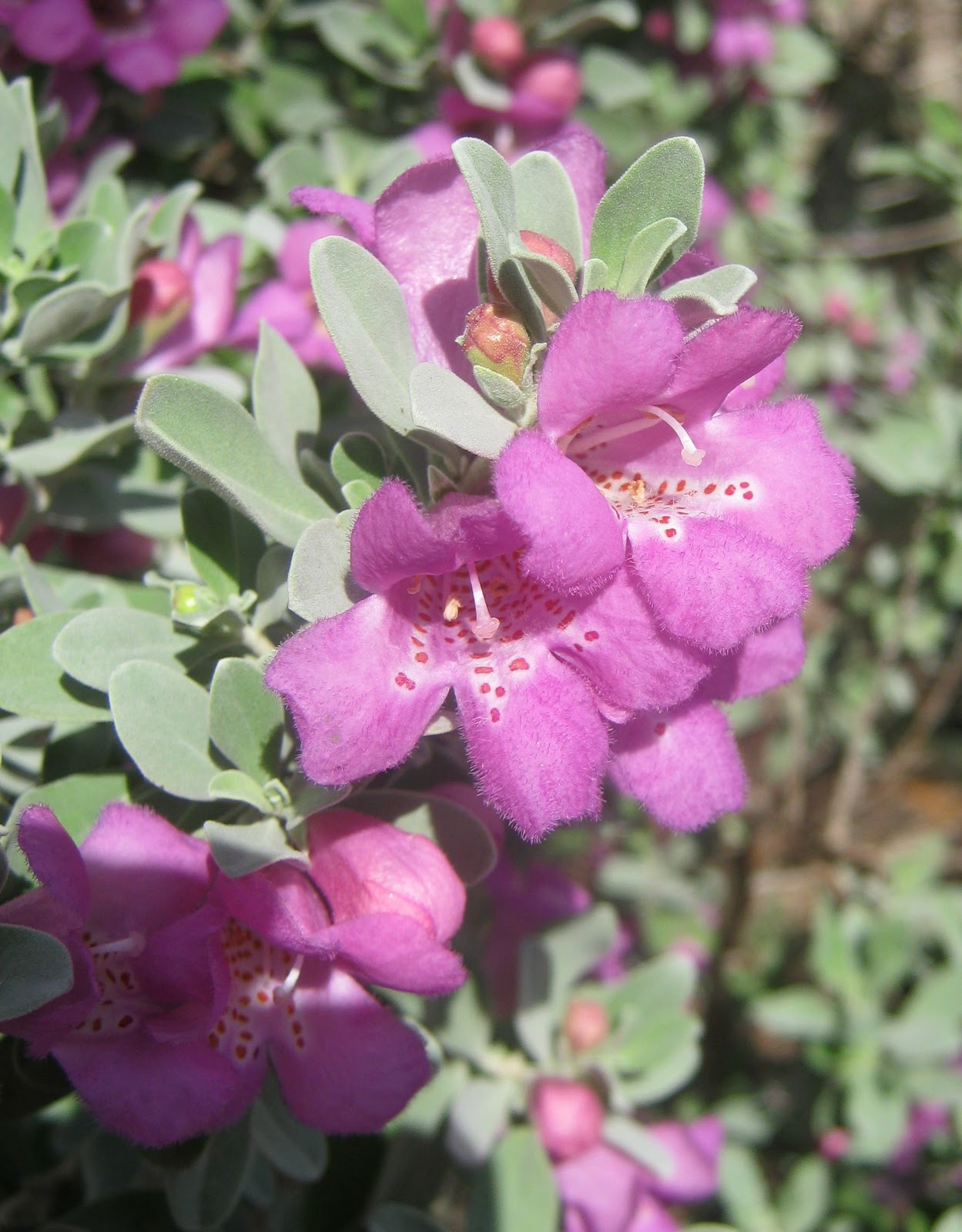
Enlarge this if you can to see the tiny hairs
covering the leaves and flower petals.
Every gardener knows that gardening is a way of preserving memories. Each of us has memories associating certain plants with beloved people and places. Gardeners preserve those memories with their plant choices.

I was reminded of a memory last week when my cenizo or purple sage (Leucophyllum frutescens) burst into bloom two weeks after recent rain.

When I entered first grade, we lived in Kermit, Texas, truly one of the state’s armpits. As I recall, it was hot, dry and dusty. Periodically dust storms would attack. Its only reason for being, as far as I could tell, was to provide my father with employment in the oil “bidness.” (We left this town after my fourth grade year, so it may not be as bad as my fourth-grade self remembers.)

But one good memory remains. I started school at Purple Sage Elementary there. I turned 7 the week after first grade began (I skipped kindergarten). I was ready to learn. Even though school has its social challenges for nerds like me, the educational challenges were mostly enjoyable. I liked school; I was good at it.

In my mind’s eye I can see a row of purple sages planted across the front of that school, brightened with lavender blooms after a rare West Texas rain.  Perhaps I associate purple sages with the advent of a new phase in my life – away from home, mother and sisters; out in the big world; in an arena in which I would be successful. I have had a soft spot for these shrubs ever since.

When we moved to the hill, my father drove up soon after wagging a cenizo dug out of his yard in North Texas, where conditions weren’t quite right. I was not ready to landscape yet, so it sat in a pot for over a year.


I finally found a spot out front in a xeric bed, semi-shaded by live oaks, tucked behind an already established yucca.  In it went, and on it has dwelled since. In this summer’s drought, its bones were showing. However, it survived the summer without supplemental water and is now blooming beautifully.

Cenizo is a southwest Texas native according to the Wildflower Research Center. It needs good drainage, likes limestone, is evergreen, blooms after rain (giving rise to another of its names – Texas barometer bush), provides nectar for butterflies and insects, survives drought and heat, and does not appeal to deer.

I have not seen any cenizos in the wild in my area, but it seems quite happy here. I’d better plant more!

Favorite spot in the garden:

I actually have three favorite places right now, but that’s not fair. I have to choose.  So I choose – this patch of new gold lantana (Lantana x hybrida ‘New Gold’). By happenstance, these three plants were put in exactly the right spot five years ago, and they have done exceedingly well. This year they have not bloomed much, but with the recent rain they have made up for lost time. Unfortunately, we may get a freeze overnight, so their glory may be short-lived. Long live the lantanas!